Feeling overwhelmed by the world of portable power? You’re not alone. The internet is a confusing mess of Watts, Watt-hours, Amps, and conflicting advice. You’re left wondering:
Is a 500Wh power station enough for a weekend camping trip?
Will a 100W solar panel actually keep my gear charged?
Am I about to waste hundreds of dollars on a solar generator that’s too small… or spend a fortune on one that’s total overkill?
Buying the wrong gear isn’t just frustrating—it can ruin a trip or leave you without power when you need it most.
Interactive Power Dashboard
Design your ideal off-grid system and see how long it lasts in real-time.
Live System Performance
–h –m
Estimated Runtime
⚡ Daily Power Use
0 Wh
☀️ Daily Solar Gain
0 Wh
1. Select Your Gear
⚡ Power Station
☀️ Solar & Weather
2. Build Your Daily Plan
Appliance Library
Stop guessing. Start planning.
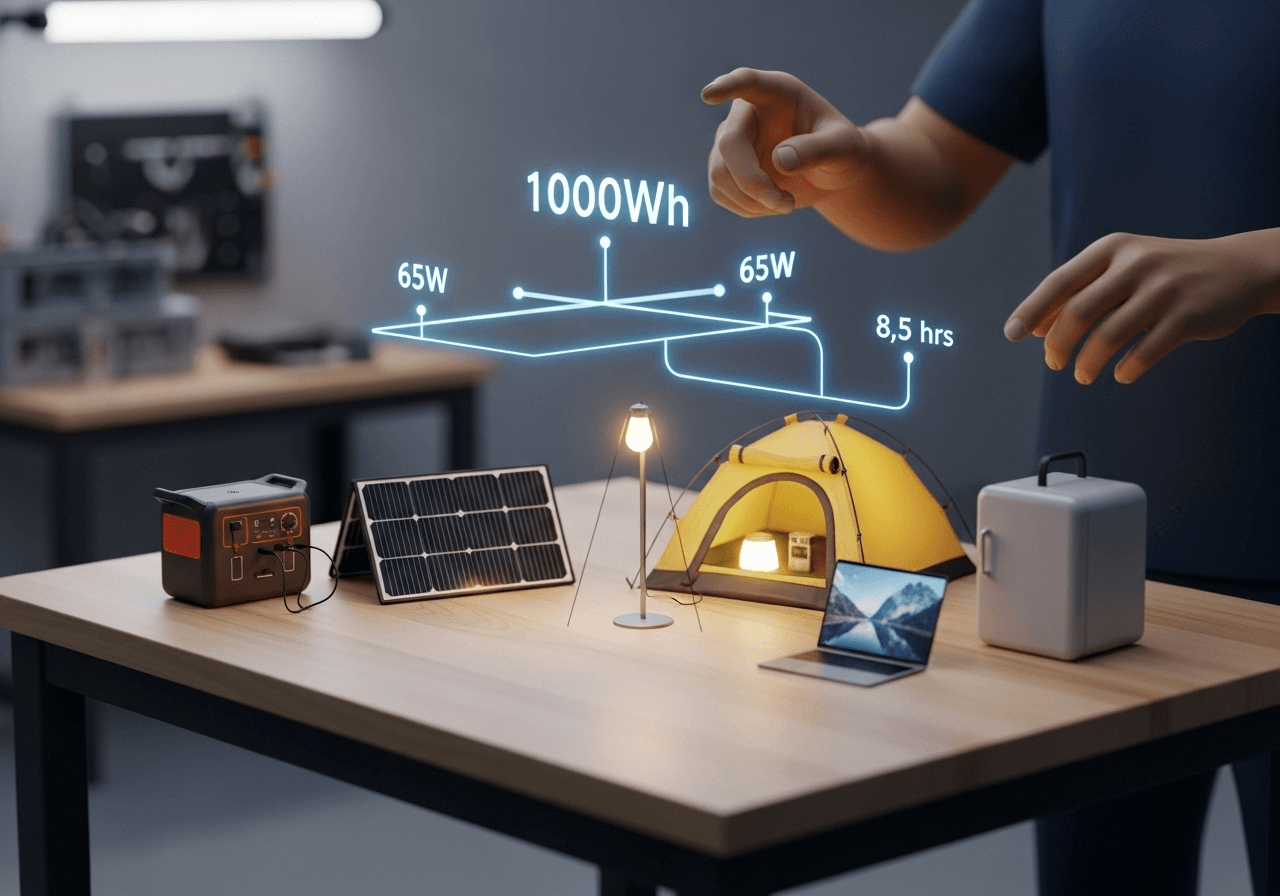
Forget complex spreadsheets and confusing jargon. We built the interactive power dashboard below to give you a clear, instant, and accurate answer. Simply select your gear, add the appliances you want to run, and watch in real-time to see if your setup can handle the load.
The Ultimate Guide to Portable Power: From Beginner to Pro
So, you’ve played with the dashboard and have a better idea of your needs. Now, let’s pull back the curtain and truly understand the “why” behind the numbers. This is your definitive guide to becoming a portable power expert in the next 5 minutes.
Watts vs. Watt-Hours: The Only Thing You Really Need to Know
This is the #1 point of confusion, but it’s actually simple. Think of it like a car:
Watts (W): Your Speedometer. This measures how fast you are using power right now. A microwave uses a lot of Watts (e.g., 1100W) for a short time. An LED light uses very few (e.g., 10W). Your power station has a max Watt rating it can handle before it shuts down.
Watt-hours (Wh): Your Gas Tank. This measures your total energy capacity. It’s how much fuel you have stored. A 500Wh station can deliver 500 watts for one hour, 50 watts for 10 hours, or 10 watts for 50 hours (minus efficiency losses).
The Takeaway: Watts determine what you can run. Watt-hours determine for how long.
The Hard Truth About Solar Panels (And How to Plan for Reality)
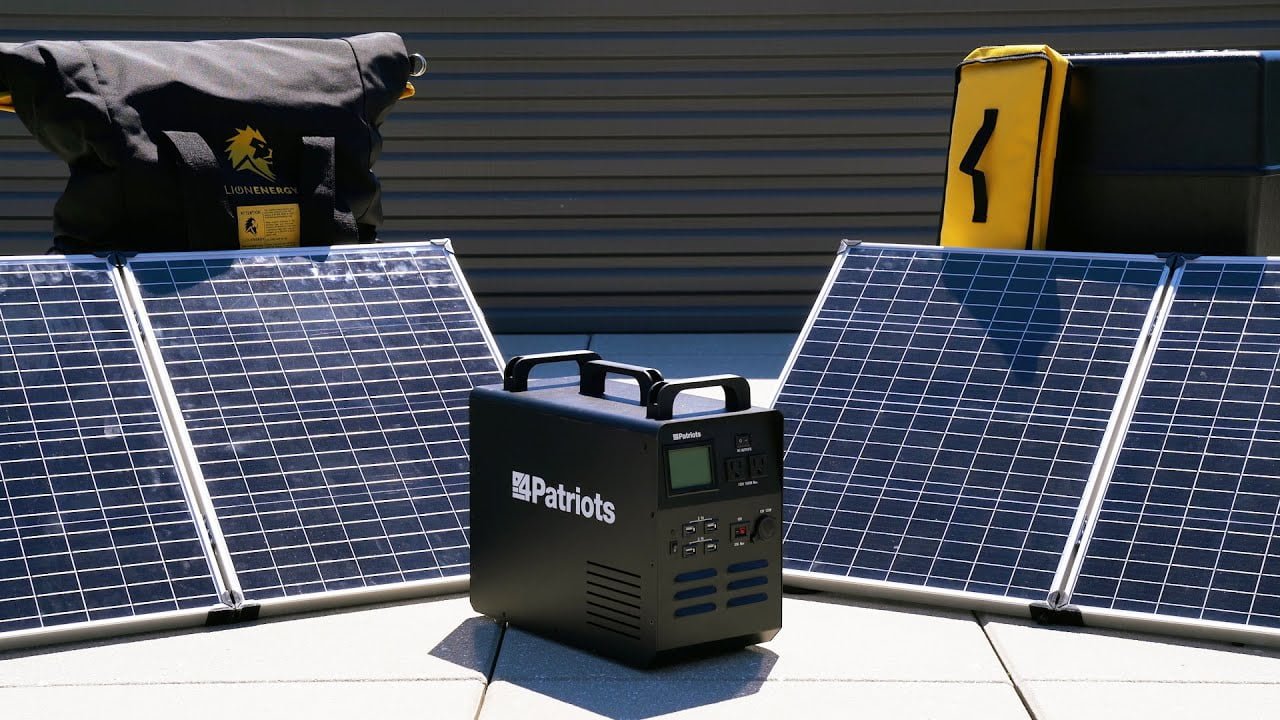
That 100W solar panel you bought? It will almost never produce 100W. Think of “100W” as its best-ever performance in perfect, laboratory-like conditions. Real-world output is affected by three key factors, which our calculator’s “Weather” setting helps simulate:
☀️ Weather: A bright, sunny day might give you 75-90% of the panel’s rated power.
⛅ Partly Cloudy: Passing clouds can drop efficiency to 40-60%.
☁️ Overcast: On a fully overcast day, you might only get 15-25%. It’s enough to trickle-charge, but not to run heavy loads.
The Takeaway: To be safe, always assume your “real-world” solar gain will be less than the number on the box. On a good day, a 100W panel might give you about 400-500Wh of charge over 5-6 hours of peak sun.
Decoding Your Appliances: The Power Hogs and the Sippers
Every device you own falls into one of two categories:
Sustained Load (The Marathon Runners): These devices use a low, consistent amount of power. Think of portable fridges, fans, laptops, and Starlink dishes. They are the primary drain on your Watt-hours (your gas tank).
Peak Load (The Sprinters): These are the power hogs that draw a massive amount of energy for a very short time. Think coffee makers, microwaves, and power tools. They test the limits of your power station’s Watts (your speedometer).
The Takeaway: A small station might have enough capacity (Wh) to run a fridge for hours, but it won’t have the output (W) to even turn on a coffee maker. Our tool helps you balance both.
Frequently Asked Questions (FAQ)
Q: How long will a 500Wh power station last?
A: It depends entirely on what you’re running. As you saw in the tool, it could run a 10W light for nearly two days, a 60W fridge for about 7-8 hours, or a 1200W coffee maker for about 20 minutes. The key is your average hourly load versus your capacity.
Q: Is 100W of solar enough for camping?
A: For a weekend warrior running lights, charging phones, and a fan, a 100W panel is often perfect, especially with a 500Wh+ station. If you need to run a fridge 24/7 or a Starlink for remote work, you will almost certainly need 200W or more to keep up.
Q: Can you really run a portable fridge off a power station?
A: Absolutely! This is one of the most popular uses. A good 12V portable fridge uses about 40-60W, but it cycles on and off. As our tool calculates, this averages out to a much lower continuous draw, making it very manageable for most medium-sized stations.
Q: What’s the difference between LiFePO4 and Lithium-Ion batteries?
A: LiFePO4 (Lithium Iron Phosphate) is the newer, better technology. It offers 4-6 times more charge cycles (lifespan) and is much safer and more stable than traditional Lithium-Ion. While slightly heavier, virtually all modern, high-quality power stations use LiFePO4.
Q: Can I charge my power station and use it at the same time?
A: Yes! This is called “pass-through charging,” and all reputable brands support it. This is the key to running sustainably off-grid. As long as your solar input is greater than your power output, you can run your gear indefinitely while still topping off your battery.
Suhas Shrikant is the founder of Vecharged and an engineering enthusiast specializing in high-power off-grid solar systems. He has designed and built over a dozen custom systems and uses his hands-on, field-tested experience to create Vecharged’s expert guides and reviews.
Vecharged is the consumer protection and education initiative of Cleanpower.eco, an organization dedicated to providing a clear, unbiased, and authoritative voice in the clean energy transition. The experts at Cleanpower.eco recognized a critical crisis of trust: the shift to electric vehicles and solar power is one of the most important and expensive decisions a family will make. Yet, the landscape is flooded with biased reviews, confusing marketing, and paid-for endorsements. Vecharged was created to be the shield against that confusion. We were founded on a simple, non-negotiable constitution: We are radically independent. We accept no advertising, sponsorships, or paid placements from any product manufacturer. We have no commercial interest in the products we review. Our only metric for success is your empowerment. Our loyalty is to you, the consumer. Full stop. We ground our brutally honest, hands-on analysis in a deep, foundational understanding of the engineering. We are not just reviewers; we are your advocates.
The question isn’t whether your EV needs oil, it’s how much money you save by eliminating the combustion system entirely. You are paying for a complex engine; the EV runs on physics. 5-Year EV Maintenance Savings Calculator Estimate how much money you save by eliminating the engine. 1. Your Current Annual Maintenance Cost (ICE Vehicle)
Let’s be brutally honest. Buying a used electric car today feels like a massive gamble. You can check the tires and look for scratches, but you have no real way of knowing the health of its most important and expensive component: the battery. You’re staring at a car that looks perfect, but you’re haunted by
A slow-motion crisis is unfolding in the tech world. We are building a future powered by brilliant, world-changing AI, but trying to run it on an electrical grid built for the last century. That crisis has now arrived. Now, a radical idea is gaining serious traction at the highest levels: that every major AI data
The new broad-duty tariff is a direct geopolitical action designed to make the EV supply chain dramatically more expensive. EV Tariff Cost Risk Calculator Estimate the potential cost increase on your battery pack from new import duties. 1. Select Your Vehicle’s Battery Size 40 kWh (Base Model / Short Range)65 kWh (Standard Long Range)90 kWh