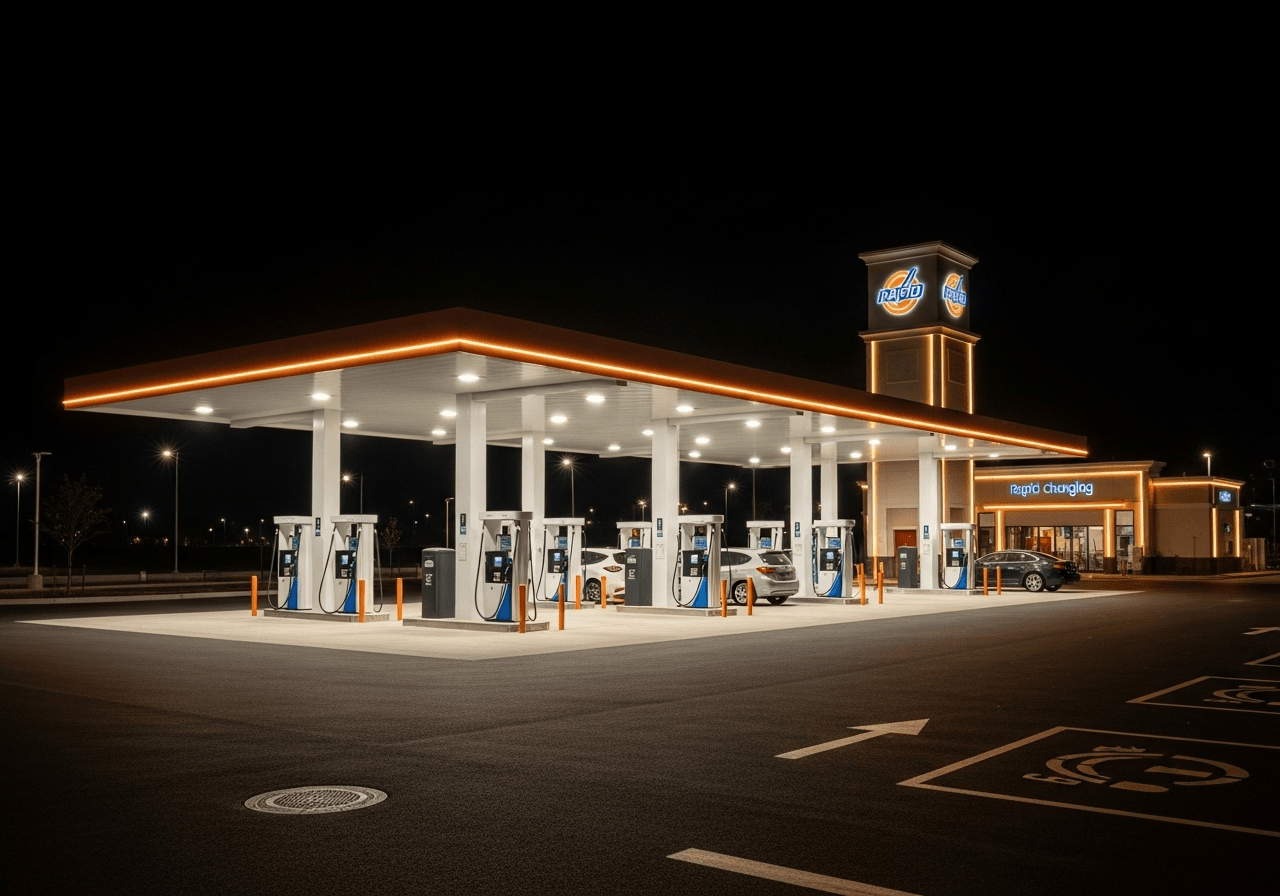
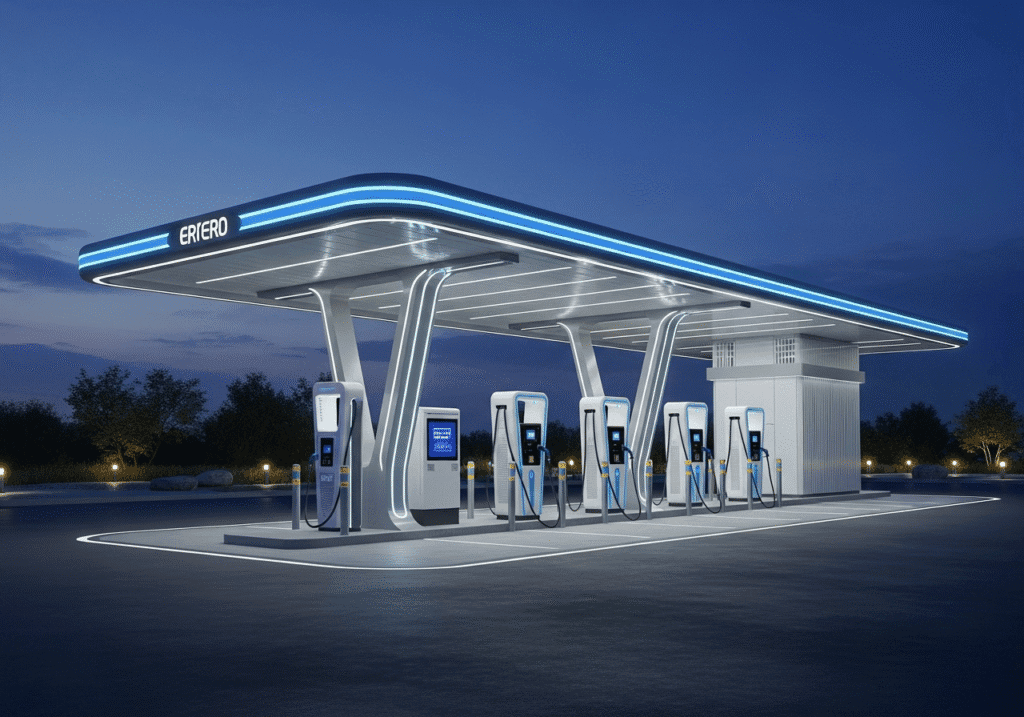
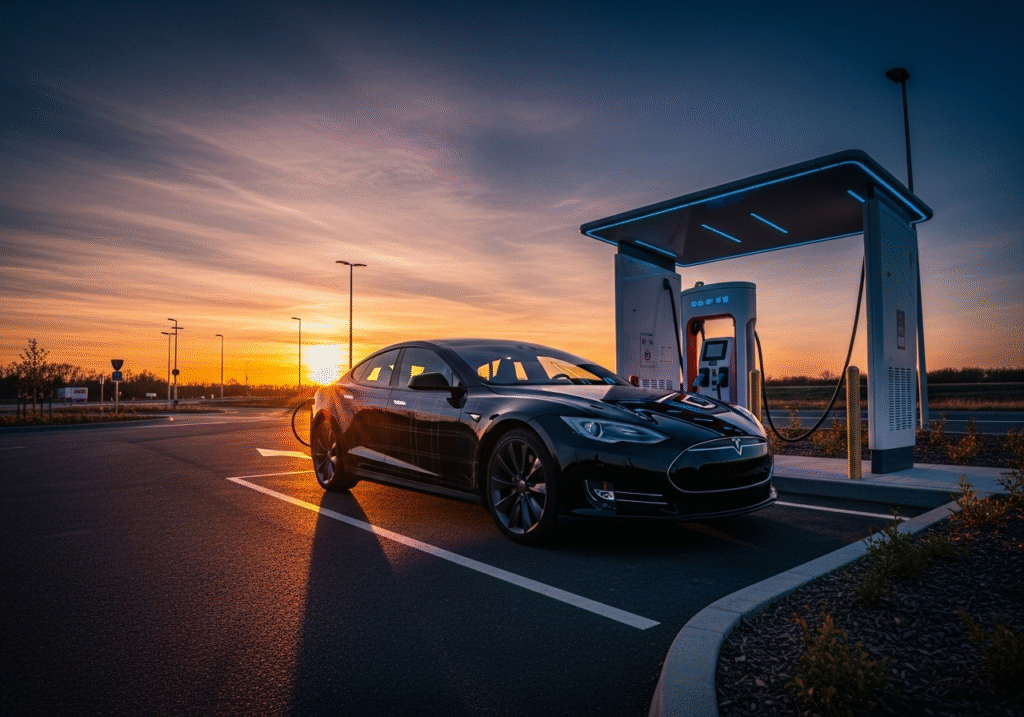
You’ve seen them. Gleaming new charging hubs popping up in the car parks of big-box stores, looking like futuristic petrol stations. The news celebrates every new “charging corridor” with dozens of high-speed chargers. It feels like progress, right? We’re taking the old model and just replacing the pump with a plug.
For years, I believed this was the way. But after living with an electric car, I’ve come to a startling conclusion: this entire strategy is based on a deeply flawed, 100-year-old assumption. We are spending billions of dollars to solve a problem that doesn’t exist anymore.
We are suffering from the “Gas Station Mindset,” and it’s leading us to build the future in all the wrong places.
Why Do Gas Stations Even Exist?
Take a step back and ask a ridiculously simple question: why do gas stations exist?
The answer is obvious: because you cannot refuel your car at home.
The entire global network of petrol stations is a brilliant solution to a fundamental limitation of the internal combustion engine. Your home doesn’t have a personal oil refinery. Refueling is a “destination” activity. You have to go somewhere else specifically to get energy.
This has shaped our cities, our habits, and our entire understanding of what it means to “fill up.” And this is where the EV revolution gets so wildly misunderstood.
The Paradigm Shift Nobody is Talking About
Electric vehicles shatter the gas station model. An EV’s fundamental superpower is that it can refuel at home. Or at work. Or at the grocery store.
The gas car model is “destination refueling.” The EV model should be “opportunity charging.”
Think of it like charging your phone. Do you wait until it’s at 1% and then make a special trip to a “phone charging station” to fill it up to 100%? Of course not. You top it up wherever you are—at your desk, by your bed, in your car. It “grazes” for power throughout the day.
So why are we spending billions to build destination “phone charging stations” for our cars?
The “Right” Places to Put Chargers Are the Most Boring Places Imaginable
The real future of EV charging isn’t about giant, expensive hubs. It’s about weaving slow, cheap, and simple charging into the fabric of our cities—in all the places where cars sit idle for hours at a time.
1. The Lamppost: The Most Overlooked Supercharger in Your City
What does every street with parked cars have? Power. And poles. Lampposts are the single greatest untapped asset for urban EV charging. They already have electricity running to them and are perfectly positioned to offer slow, overnight charging to the millions of people who live in apartments and park on the street. This isn’t a fantasy; cities like London are already doing it.
2. The Workplace Parking Lot: The 8-Hour Goldmine
Where does a car spend its longest, most predictable chunk of time? At your office parking lot. A car sitting for 8-9 hours doesn’t need a super-fast, expensive DC charger. A simple, slow Level 2 charger can easily provide a full charge in that time, powered by office buildings that might even have solar panels on the roof.
3. The Supermarket & Shopping Mall: The “Top-Up” Zone
You spend an hour or two at the grocery store or mall. A slow charger could easily add 20-40 miles of range in that time—more than enough to cover the average daily commute. It turns a chore into an “opportunity charge.”
So, What is the Point of Fast Chargers?
Am I saying we should tear down all the DC Fast Chargers? Absolutely not. They are critically important, but for one specific purpose: long-distance travel.
Fast chargers belong on highways, connecting cities. They are the 21st-century equivalent of the highway rest stop, enabling road trips. They are not the solution for daily, urban life. Using them for that is like using a fire hose to water a houseplant.
Conclusion: Let’s Build a Smarter Future, Not Just an Electric Past
The transition to electric vehicles gives us a once-in-a-century opportunity to rethink our relationship with energy and our cities.
Let’s stop clinging to the “Gas Station Mindset.” Let’s stop building expensive “destinations” and start building a smart, distributed, and convenient charging fabric that meets us where we already are.
The future of charging isn’t about making a special trip. It’s about power being so readily available in the boring, everyday places that you never have to think about it again.
Suhas Shrikant is the founder of Vecharged and an engineering enthusiast specializing in high-power off-grid solar systems. He has designed and built over a dozen custom systems and uses his hands-on, field-tested experience to create Vecharged’s expert guides and reviews.
Vecharged is the consumer protection and education initiative of Cleanpower.eco, an organization dedicated to providing a clear, unbiased, and authoritative voice in the clean energy transition. The experts at Cleanpower.eco recognized a critical crisis of trust: the shift to electric vehicles and solar power is one of the most important and expensive decisions a family will make. Yet, the landscape is flooded with biased reviews, confusing marketing, and paid-for endorsements. Vecharged was created to be the shield against that confusion. We were founded on a simple, non-negotiable constitution: We are radically independent. We accept no advertising, sponsorships, or paid placements from any product manufacturer. We have no commercial interest in the products we review. Our only metric for success is your empowerment. Our loyalty is to you, the consumer. Full stop. We ground our brutally honest, hands-on analysis in a deep, foundational understanding of the engineering. We are not just reviewers; we are your advocates.
Electric mountain bikes (or e-MTBs) are revolutionizing the off-road experience. Whether you’re a seasoned trailblazer or a newcomer to mountain biking, e-MTBs offer a unique blend of pedal-power and electric assist, making even the toughest climbs and longest adventures achievable. What is an Electric Mountain Bike? At its core, an e-MTB looks like a traditional
Introduction: The F-150 Lightning, America’s best-selling electric truck, is getting even more compelling. Ford isn’t just dropping prices across the lineup – they’re upping the ante with more range, innovative tech, and new trim levels that deliver incredible value. Let’s dive into why the F-150 Lightning is the ultimate electric workhorse. 2024 F-150 Lightning Pricing
Calling all EV enthusiasts, shake up those preconceptions! Xiaomi’s long-awaited SU7 electric sedan just hit the market, and it’s bringing serious heat. CEO Lei Jun boldly claims the SU7 outperforms even Tesla, but the truly shocking part is the price. Buckle up, because the EV game just changed. The Need for Speed? You Got It.
A Market Lagging Behind, But Catching Up Quickly The Indian EV market, though nascent compared to developed nations, is experiencing rapid growth. While factors like lack of charging infrastructure, focus on affordable small vehicles with limited range, and general lack of awareness remain hurdles, the government’s push through subsidies and incentives (like the FAME scheme)