As the first generation of solar panels installed across America in the early 2000s now reaches maturity, that question is no longer theoretical. We’re at a critical turning point. But this isn’t a story about failure. It’s the story of a challenge that brilliant engineers and entrepreneurs are turning into a massive opportunity.
The Slow Fade, Not a Sudden Death
Let’s get one thing straight: your solar panels won’t just switch off on their 25th birthday. I’ve seen 20-year-old panels still performing beautifully. The “end-of-life” we talk about is actually a slow, predictable process called degradation.
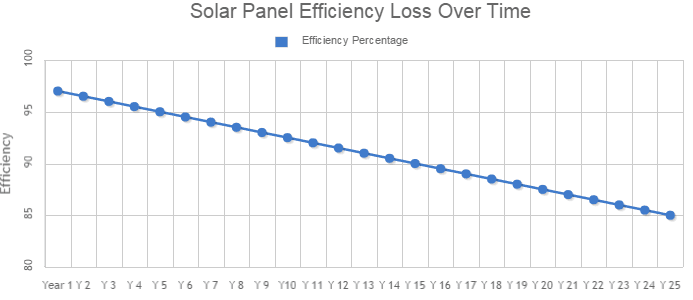
A 25-year-old panel still works, often at 80-90% of its original power. The decision to replace them is purely economic: today’s new panels can produce more than double the power in the same roof space, making an upgrade a smart financial move for many homeowners.
See Degradation in Action
Use this interactive calculator to see how a typical solar panel’s performance declines over its 25-year life.
Solar Panel Degradation Calculator
Year
1
Predicted Output
400 W
Efficiency vs. Original
100%
25-Year Performance Curve
The Coming Wave We Must Prepare For
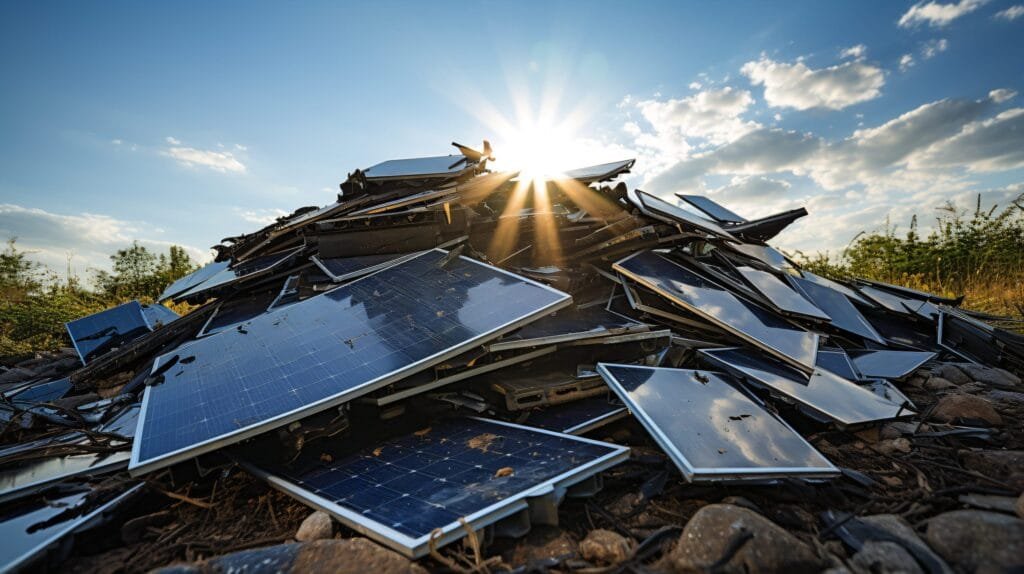
This wave of upgrades means millions of tons of retired panels will enter the waste stream in the US alone. Simply landfilling them is a huge mistake. While the panels are safe in normal use, breakage in a landfill could allow trace metals to leach into the soil. More importantly, it’s a colossal waste of valuable materials like glass, silver, and high-purity silicon.
The Journey of a Retiring Panel: Birth of a New Industry
Fortunately, a new American recycling industry is turning this “waste” into a resource. The high-tech process is a form of “urban mining“:
Deconstruction: The valuable aluminum frame and copper wiring are stripped for easy recycling.
Separation: Specialized thermal or mechanical processes separate the panel’s glass from the silicon cells within.
Recovery: In advanced facilities, up to 95% of key materials are recovered and sold back into industrial commodity markets, reducing the need for new mining.
The Policy Blueprint: Learning from the Leaders
While the technology is here, US policy is a patchwork of state laws with no federal mandate. In contrast, the European Union requires manufacturers to be financially responsible for recycling the products they sell. This “producer responsibility” model has created a mature and efficient recycling market and provides a clear blueprint for the US and rapidly growing markets like India.
From my perspective, this isn’t a crisis; it’s the solar industry’s graduation. We’ve proven the technology works for the long haul. Now, we’re building the circular economy to manage its entire lifecycle. While the US recycling industry is still in its early phase, the potential is immense—not just to protect the environment, but to create American jobs and secure our clean energy future.
I’m a writer and analyst who explores the clean energy transition, with a focus on electric vehicles and solar power.
My journey began five years ago as a firm skeptic. Determined to debunk the hype around EVs, my in-depth research led to an unexpected conclusion: the future I was questioning was already here. This realization didn’t just change my mind; it put me in the driver’s seat of my own EV.
Today, I’m passionate about sharing the clarity I found. I provide the practical, data-driven insights people need to feel confident and excited about navigating their own path to a sustainable future.
Vecharged is the consumer protection and education initiative of Cleanpower.eco, an organization dedicated to providing a clear, unbiased, and authoritative voice in the clean energy transition. The experts at Cleanpower.eco recognized a critical crisis of trust: the shift to electric vehicles and solar power is one of the most important and expensive decisions a family will make. Yet, the landscape is flooded with biased reviews, confusing marketing, and paid-for endorsements. Vecharged was created to be the shield against that confusion. We were founded on a simple, non-negotiable constitution: We are radically independent. We accept no advertising, sponsorships, or paid placements from any product manufacturer. We have no commercial interest in the products we review. Our only metric for success is your empowerment. Our loyalty is to you, the consumer. Full stop. We ground our brutally honest, hands-on analysis in a deep, foundational understanding of the engineering. We are not just reviewers; we are your advocates.
Portable Power Stations: Ignore the Specs & Learn These 2 Numbers I’ve been there. You’re standing in a store or scrolling online, looking at a wall of orange, black, and grey boxes all promising “power anywhere.” They’re called power stations, solar generators, and they all look vaguely the same. The specs are a nightmare: Wh,
Home Solar for My EV: My Surprising 4-Year Payback Period That first sip of morning coffee hits different when you know your car is in the driveway, filling up with sunshine. No gas stations, no volatile fuel prices, and an electricity bill so low it looks like a typo. This was the dream that sent
How to Keep Your EV Battery Healthy (And Maximize Its Value) Let’s talk about the elephant in the room: the battery. When I got my first electric car, I was thrilled. The silent acceleration, the smooth ride, the freedom from petrol bunks… it was amazing. But a tiny, nagging thought was always in the back
Introduction: Ending the Confusion Around Home EV Chargers Choosing the right home EV charger can feel overwhelming. Different voltage standards, charging speeds, safety considerations, installation costs, and government incentives vary widely across regions—especially the US, UK, and Australia. At Vecharged, we understand your frustration with generic lists that don’t reflect your specific situation. This definitive