For over a century, the value of an automobile was forged in steel and measured in horsepower. That era is over. The automotive semiconductor market, valued at over $70 billion in 2025, is projected to surge to more than $120 billion by the early 2030s, and the battle for its most valuable segment—centralized compute—is a war fought in trillions of operations per second (TOPS).
The modern car is a computer on wheels, and its value is now measured by the power of its silicon heart. This fundamental shift has ignited a brutal conflict for control of the vehicle’s “digital chassis.” The legacy automotive supply chain is being upended, and the winners of this new silicon war—pitting giants like NVIDIA, Qualcomm, Intel (Mobileye), and AMD against each other—will not just supply a part; they will define the very architecture and identity of the automobile for the next generation.
The Great Consolidation: From 100 ECUs to a Single Brain
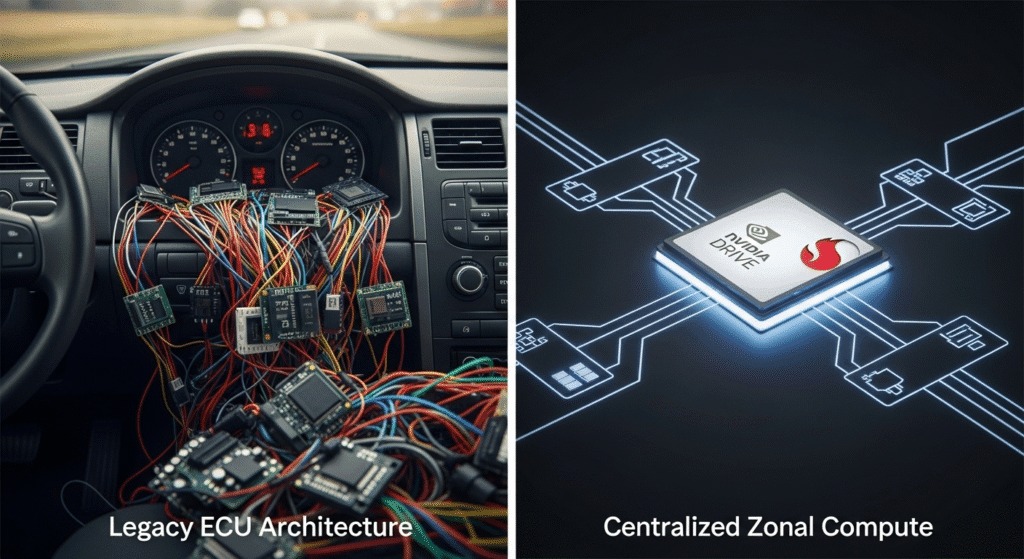
To grasp the scale of this battle, one must first appreciate the architectural revolution. A traditional car contains a sprawling, decentralized network of 80 to 150 individual Electronic Control Units (ECUs). This creates a complex, heavy, and inflexible “spaghetti” of wiring that is impossible to update meaningfully over the air.
The software-defined vehicle (SDV) demolishes this model. Inspired by Tesla, automakers are stampeding towards a centralized or zonal compute architecture. Here, the dozens of small ECUs are consolidated into a handful of powerful domain controllers, all managed by one or two central “supercomputers” or Systems on a Chip (SoCs) that run a software stack now exceeding 150 million lines of code.
Deep Dive: Strategies and Market Position
1. NVIDIA: The Full-Stack AI Brain
NVIDIA’s strategy is a top-down assault, leveraging its dominance in AI data centers to own the vehicle’s autonomous brain. Their automotive design-win pipeline now stands at over $14 billion.
Technology: The current-generation DRIVE Orin SoC (254 TOPS) is already a powerhouse in production vehicles. But the true weapon is the next-generation DRIVE Thor, a single “superchip” delivering an astonishing 2,000 TOPS designed to centralize everything from autonomous driving to infotainment. The first Thor-powered vehicles are slated for production in 2025.
Strategy: NVIDIA is selling a turnkey, vertically integrated system, attractive to automakers who want a best-in-class AV solution without the massive R&D of developing their own software stack.
2. Qualcomm: The Modular Digital Chassis
Leveraging its mobile dominance, Qualcomm has become an automotive titan, boasting the industry’s largest design-win pipeline, valued at over $40 billion.
Technology: The Snapdragon Digital Chassis is a suite of platforms. While the Snapdragon Cockpit platform is the market leader for infotainment, their Snapdragon Ride platform for ADAS is highly scalable, offering solutions from 30 TOPS up to 2,000+ TOPS.
Strategy: Qualcomm’s modular “best-of-breed” approach resonates with legacy automakers like GM and BMW, who are wary of ceding total control of the vehicle’s brain to a single supplier.
3. Intel (via Mobileye): The Incumbent ADAS Specialist
Intel’s primary weapon is its subsidiary, Mobileye, which still dominates the ADAS landscape with an estimated market share that analysts place as high as 80% for vision-based safety systems.
Technology: Mobileye’s EyeQ family of SoCs are highly efficient, lean processors. Their future is pinned on the EyeQ Ultra, a purpose-built AV-on-a-chip delivering 176 TOPS at high efficiency.
Strategy: Mobileye offers a full-stack, vision-first “black box”—their chip, cameras, crowdsourced maps (REM), and proprietary driving policy software, making them the trusted, default partner for regulated safety features for years.
4. AMD: The Powerful Enabler
While not offering a full platform, AMD has secured a critical beachhead in the automotive market.
Technology: AMD’s major coup was securing the infotainment processor spot in Tesla’s entire vehicle lineup with its powerful Ryzen APUs, providing the gaming-level performance that defines Tesla’s user experience.
Strategy: AMD is executing a focused strategy to be the premier supplier for the increasingly complex digital cockpit, leveraging its PC and console gaming expertise.
The Road Ahead: A New Automotive Value Chain
The strategic implications are profound. The battle is forcing automakers to redefine themselves as software integrators. The choice of a silicon partner, a decision that now happens 5-7 years before a car hits the road, is arguably more critical than the choice of a battery supplier.
Geopolitical factors, particularly the industry’s reliance on TSMC for advanced chip fabrication, add another layer of systemic risk. The automakers that will win the next decade will be those that master this new, complex value chain. The heart of the car is now a chip, and the design wins announced today are the clearest indicator of the automotive leaders of 2030.
I’m a writer and analyst who explores the clean energy transition, with a focus on electric vehicles and solar power.
My journey began five years ago as a firm skeptic. Determined to debunk the hype around EVs, my in-depth research led to an unexpected conclusion: the future I was questioning was already here. This realization didn’t just change my mind; it put me in the driver’s seat of my own EV.
Today, I’m passionate about sharing the clarity I found. I provide the practical, data-driven insights people need to feel confident and excited about navigating their own path to a sustainable future.
Vecharged is the consumer protection and education initiative of Cleanpower.eco, an organization dedicated to providing a clear, unbiased, and authoritative voice in the clean energy transition. The experts at Cleanpower.eco recognized a critical crisis of trust: the shift to electric vehicles and solar power is one of the most important and expensive decisions a family will make. Yet, the landscape is flooded with biased reviews, confusing marketing, and paid-for endorsements. Vecharged was created to be the shield against that confusion. We were founded on a simple, non-negotiable constitution: We are radically independent. We accept no advertising, sponsorships, or paid placements from any product manufacturer. We have no commercial interest in the products we review. Our only metric for success is your empowerment. Our loyalty is to you, the consumer. Full stop. We ground our brutally honest, hands-on analysis in a deep, foundational understanding of the engineering. We are not just reviewers; we are your advocates.
Portable Power Stations: Ignore the Specs & Learn These 2 Numbers I’ve been there. You’re standing in a store or scrolling online, looking at a wall of orange, black, and grey boxes all promising “power anywhere.” They’re called power stations, solar generators, and they all look vaguely the same. The specs are a nightmare: Wh,
Home Solar for My EV: My Surprising 4-Year Payback Period That first sip of morning coffee hits different when you know your car is in the driveway, filling up with sunshine. No gas stations, no volatile fuel prices, and an electricity bill so low it looks like a typo. This was the dream that sent
How to Keep Your EV Battery Healthy (And Maximize Its Value) Let’s talk about the elephant in the room: the battery. When I got my first electric car, I was thrilled. The silent acceleration, the smooth ride, the freedom from petrol bunks… it was amazing. But a tiny, nagging thought was always in the back
Introduction: Ending the Confusion Around Home EV Chargers Choosing the right home EV charger can feel overwhelming. Different voltage standards, charging speeds, safety considerations, installation costs, and government incentives vary widely across regions—especially the US, UK, and Australia. At Vecharged, we understand your frustration with generic lists that don’t reflect your specific situation. This definitive