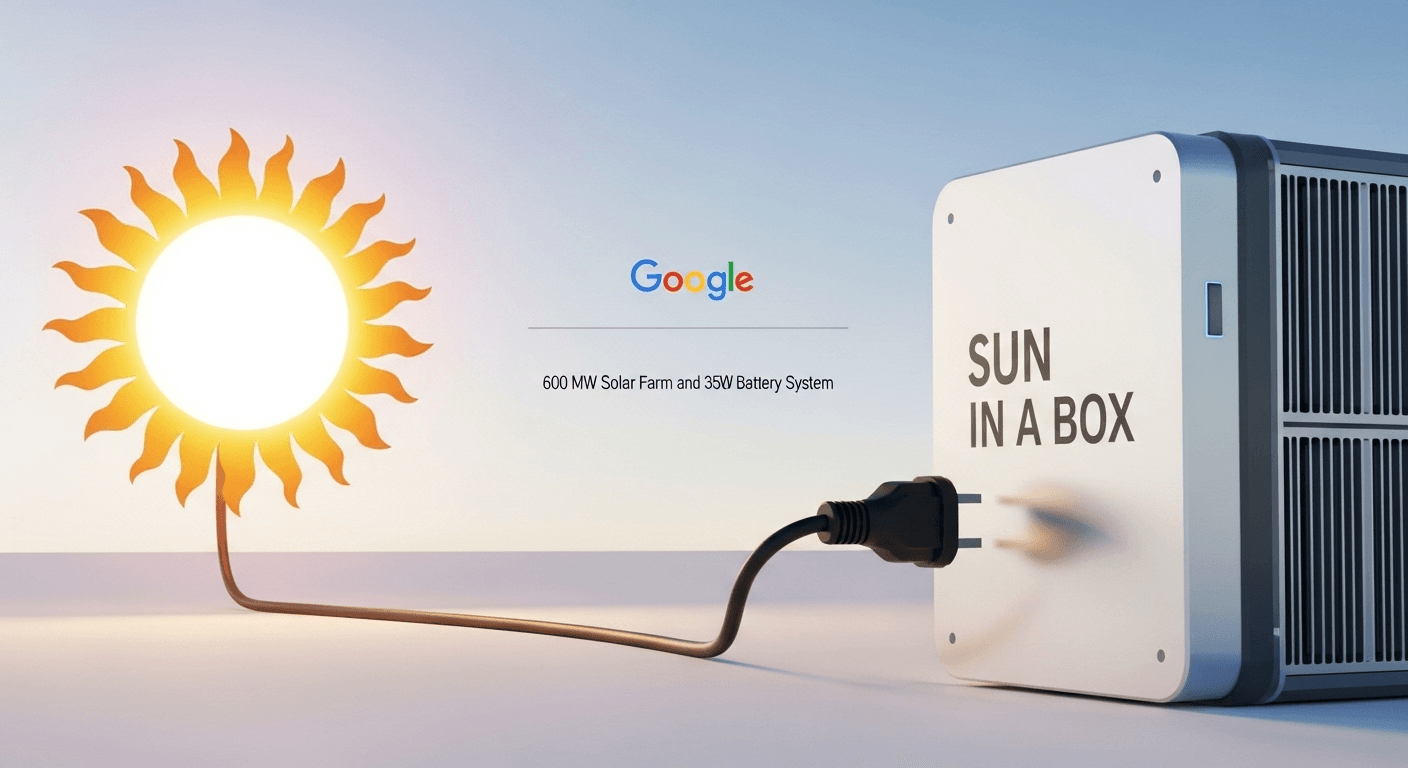
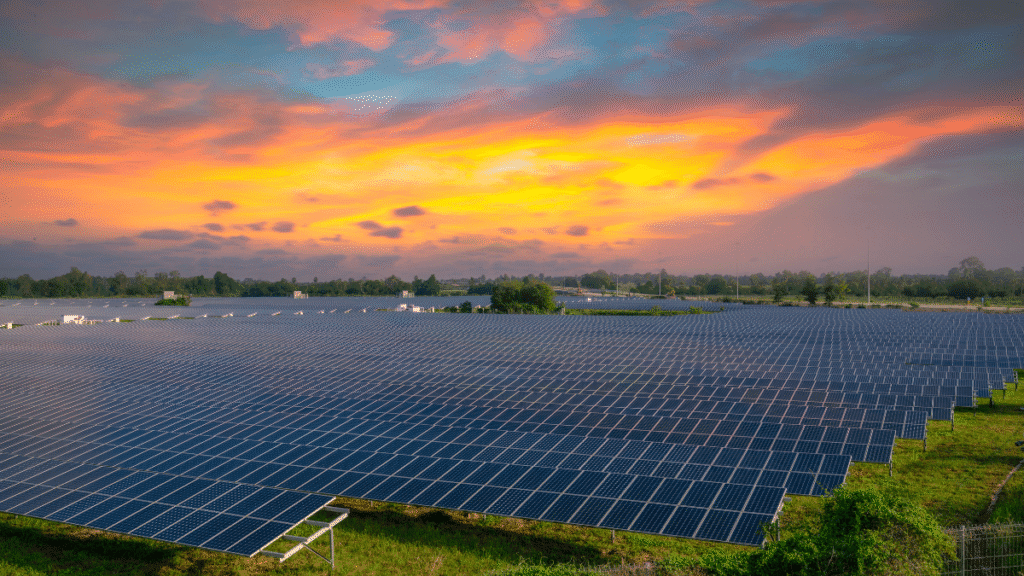
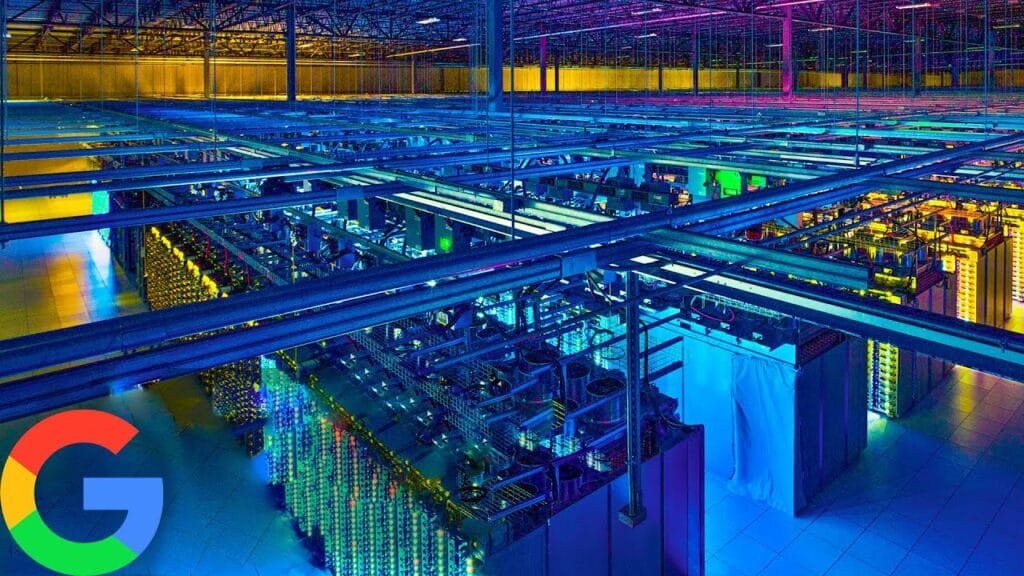
The most important part of this story isn’t just the massive solar farm; it’s what sits alongside it: a giant 350-megawatt battery system, a virtual ‘sun in a box.’ This combination of solar and storage is not just another green initiative; it’s a real-world blueprint for the future of reliable, clean energy for everyone.
Solving Solar’s Oldest Problem
Solar power has always had a fundamental weakness: the sun sets every night. A solar farm without storage is like a massive river without a dam. It provides immense power when it’s flowing strong during the day, but it becomes useless during a drought (at night).
The battery is the dam. It captures the massive rush of solar energy during the day and releases it as a steady, reliable flow all night long. This single innovation turns an intermittent power source into a dependable, 24/7 utility.
The Real Goal: From “100% Renewable” to “24/7 Carbon-Free”
For years, the gold standard for green companies was to be “100% renewable.” This was an accounting exercise. A company could use fossil fuel energy at night and simply buy enough Renewable Energy Credits (RECs) from a wind or solar farm elsewhere to balance out their carbon footprint over the course of a year.
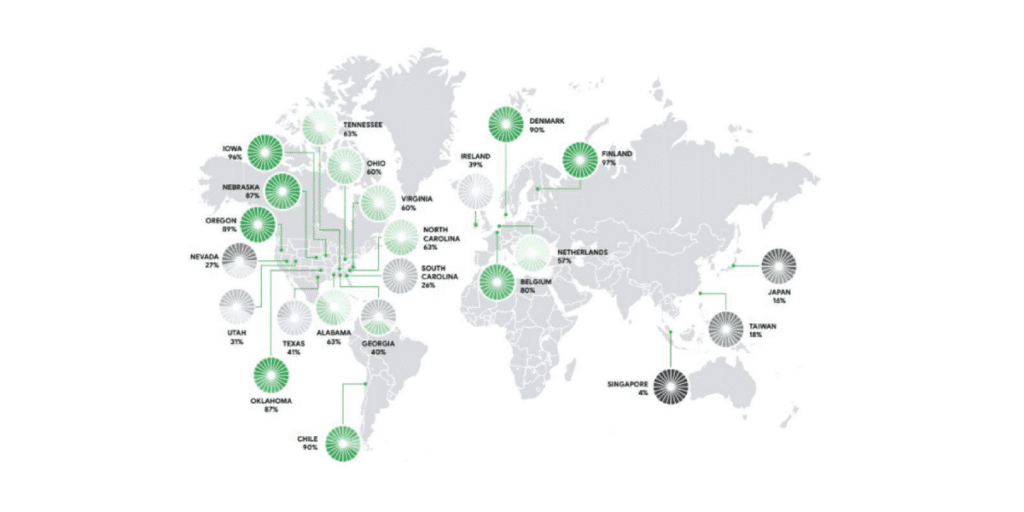
Google’s goal is far more ambitious: “24/7 Carbon-Free Energy.” This means matching the energy consumption of their facilities with clean energy every hour of every day. You can’t achieve this by just buying credits. You need a system that can provide clean power even when the sun isn’t shining. This is why battery storage is the secret weapon.
The Scale: The project consists of a 600 MW solar farm and a 350 MW battery system built on about 1,200 acres of land.
The Deal: Google has an agreement to purchase the Renewable Energy Credits (RECs) from this facility. Think of RECs as certificates proving clean energy was generated. Google uses these to certify that the energy it consumes is matched with carbon-free sources on the grid.
The Smart Grid: This isn’t just about generating power; it’s about being a good partner to the grid. Google also uses “demand response,” intelligently adjusting its data centers’ energy use in real-time to match when clean power is most abundant. This helps make the entire grid more stable and efficient.
What This Blueprint Means for India (And the World)
The Google project proves that the technology to provide stable, 24/7 clean power at a massive scale is no longer theoretical.
This “solar + storage” combination is the key to solving India’s biggest energy challenges: managing the high evening peak demand, providing stable power despite an unreliable grid, and truly unlocking the country’s immense solar potential.
The future isn’t just about making more clean energy. It’s about storing, managing, and delivering it intelligently, 24 hours a day. This project is a real-world signal that this future has finally begun.
I’m a writer and analyst who explores the clean energy transition, with a focus on electric vehicles and solar power.
My journey began five years ago as a firm skeptic. Determined to debunk the hype around EVs, my in-depth research led to an unexpected conclusion: the future I was questioning was already here. This realization didn’t just change my mind; it put me in the driver’s seat of my own EV.
Today, I’m passionate about sharing the clarity I found. I provide the practical, data-driven insights people need to feel confident and excited about navigating their own path to a sustainable future.
Vecharged is the consumer protection and education initiative of Cleanpower.eco, an organization dedicated to providing a clear, unbiased, and authoritative voice in the clean energy transition. The experts at Cleanpower.eco recognized a critical crisis of trust: the shift to electric vehicles and solar power is one of the most important and expensive decisions a family will make. Yet, the landscape is flooded with biased reviews, confusing marketing, and paid-for endorsements. Vecharged was created to be the shield against that confusion. We were founded on a simple, non-negotiable constitution: We are radically independent. We accept no advertising, sponsorships, or paid placements from any product manufacturer. We have no commercial interest in the products we review. Our only metric for success is your empowerment. Our loyalty is to you, the consumer. Full stop. We ground our brutally honest, hands-on analysis in a deep, foundational understanding of the engineering. We are not just reviewers; we are your advocates.
Elon Musk has never been shy about moonshot goals. When it comes to electric vehicles (EVs), achieving ever-greater range, faster charging times, and lower costs are paramount. Enter the Tesla 4680 battery cell, unveiled by Musk himself at Tesla Battery Day in September 2020. Promised to be a revolutionary leap forward, the 4680’s fate seems
Duracell Energy is making waves in the home energy storage market with the introduction of their two new home battery systems: the Dura5 and Dura5+. These innovative batteries cater to different needs, offering homeowners flexibility and control over their energy usage. Let’s delve into the details of each system: Dura5: The Indoor Powerhouse Designed for
Blackouts got you down? Wish you could harness the sun’s power even at night? Battery Energy Storage Systems (BESS) are here to change the game! This article dives deep into BESS, explaining what they are, the benefits they offer, and how to choose and install the perfect system for your home. So what exactly is
BYD, a Chinese automaker, is making a bold move by challenging Toyota in its home turf, Japan. The company is launching its third electric car in Japan, the Seal EV, which is expected to compete directly with the popular Tesla Model 3. Seal EV Launched as BYD Challenges Toyota The Seal EV is a sedan