A deep dive into Toyota’s claimed 10-minute charge for a 1,200 km range, why this changes everything for the electric vehicle industry, and what it means for you.
For over a decade, the electric vehicle revolution has felt like a steady climb up a steep mountain. Every year, batteries get a little better, range increases by a few dozen kilometers, and charging times get incrementally shorter. It has been a story of evolution.
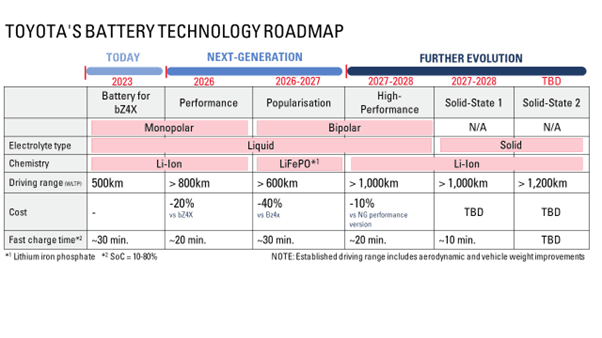
Today, that story has changed. Reports are breaking that Toyota has achieved a monumental manufacturing breakthrough in solid-state battery technology. The claims are so staggering they feel like they belong in a science fiction novel:
A range of 1,200 km (750 miles) on a single charge.
The ability to recharge from 10% to 80% in just 10 minutes.
If these claims hold true, this is not evolution; it’s a paradigm shift. This isn’t just another step up the mountain; it’s a vehicle that teleports us to the summit. But to understand the magnitude of this moment, we first need to understand the technology itself.
The Explainer: What is a Solid-State Battery?
This is where you, as a reader, will gain your expertise. The difference between current and solid-state batteries is surprisingly simple.
Think of a traditional lithium-ion battery (the kind in your phone and current EVs) as a wet sponge. It uses a liquid chemical cocktail called an electrolyte to shuttle energy between the positive and negative sides. This liquid is heavy, flammable, and can degrade, forming dendrites that reduce the battery’s lifespan.
A solid-state battery is a dry sponge. It replaces that volatile liquid with a thin, solid material—often a ceramic or polymer. This single change has massive consequences.
Feature
Lithium-Ion (The Old Way)
Solid-State (The Toyota Breakthrough)
Electrolyte
Liquid (Flammable)
Solid (Stable)
⚡️ Energy Density
Good
Dramatically Higher (More power in less space)
⏱️ Charging Speed
Limited by heat
Extremely Fast (Less risk of degradation)
🔥 Safety
Fire Risk
Virtually Fireproof
🔋 Lifespan
Good (8-10 years)
Potentially Longer (Fewer side reactions)
The Range Revolution: Visualizing 1,200 Kilometers
A 1,200 km range isn’t just a number; it fundamentally changes the psychology of owning an electric car. It means driving from Mumbai to Delhi with only one short stop. It means a week—or even two—of daily commuting without ever needing to plug in at home.
To put this leap into perspective, here’s how it compares to some of the best long-range EVs on the market today.
Bar 2: Premium Long-Range EV (e.g., Lucid Air) – ~830 km
Bar 3: Toyota Solid-State Claim – 1,200 km
Interactive Tool: The EV Charging Time Calculator
The most potent claim is the 10-minute charge. It attacks the psychological barrier of the ticking clock at the charging station. We’ve built a simple interactive tool to help you feel the difference.
Drag the slider to set your desired driving range and see how long you’d wait with today’s technology versus Toyota’s breakthrough.
Interactive: Charging Time Showdown
Required Range:600 km
Lithium-Ion (Today)
36 mins
Solid-State (Future)
5 mins
The time it takes to grab a coffee and a snack.
The Big Picture: What This Means for Everyone
This isn't just about Toyota vs. Tesla. This is a fundamental shift that will create ripple effects across the entire global economy.
The Leveling of the Playing Field: For years, Tesla's primary competitive advantage has been its superior battery technology and charging network. If a legacy automaker like Toyota can leapfrog them on the core technology, the entire power balance of the auto industry shifts.
The Death of the Gas Station Model: The need for gas stations disappears when your "refueling" takes 10 minutes at a destination charger (like a grocery store) or happens overnight at home. This technology accelerates the demise of fossil fuel infrastructure.
A Boom for the Used EV Market: A key concern for used EV buyers is battery degradation. With solid-state batteries promising a much longer lifespan, a 5-year-old EV could become a far more attractive and reliable purchase, stabilizing resale values and making EVs accessible to more people.
Conclusion: The Domino Has Fallen
Toyota, long criticized by some as being too slow in the EV race, may have just revealed they weren't running a sprint; they were patiently setting up the first, most crucial domino in a much grander game. The science of solid-state batteries has been known for years, but the challenge was always mass production.
By reportedly solving this manufacturing puzzle, Toyota has not just announced a new battery. They have announced the beginning of the end for the internal combustion engine. They have vaporized the final, most stubborn arguments against going electric—range anxiety and long charge times.
We are not just looking at the next great battery; we are looking at the future, and it has finally arrived.
Suhas Shrikant is the founder of Vecharged and an engineering enthusiast specializing in high-power off-grid solar systems. He has designed and built over a dozen custom systems and uses his hands-on, field-tested experience to create Vecharged’s expert guides and reviews.
Vecharged is the consumer protection and education initiative of Cleanpower.eco, an organization dedicated to providing a clear, unbiased, and authoritative voice in the clean energy transition. The experts at Cleanpower.eco recognized a critical crisis of trust: the shift to electric vehicles and solar power is one of the most important and expensive decisions a family will make. Yet, the landscape is flooded with biased reviews, confusing marketing, and paid-for endorsements. Vecharged was created to be the shield against that confusion. We were founded on a simple, non-negotiable constitution: We are radically independent. We accept no advertising, sponsorships, or paid placements from any product manufacturer. We have no commercial interest in the products we review. Our only metric for success is your empowerment. Our loyalty is to you, the consumer. Full stop. We ground our brutally honest, hands-on analysis in a deep, foundational understanding of the engineering. We are not just reviewers; we are your advocates.
Selling an electric car is very different from selling a petrol or diesel vehicle. Buyers today care less about the odometer and more about battery health, charging history, warranty coverage, and software features. The good news is that a well-maintained EV can still command strong resale value if you prepare it properly. This guide gives
By Rahul — EV owner, reviewer, and long-time clean energy enthusiast Financing or leasing an electric car in early 2026 is not the same as it was just one year ago. The biggest shift was the end of all federal EV tax credits on September 30, 2025, including: Manufacturers can no longer claim any of
By Rahul — EV Enthusiast & Automotive Analyst at VeCharged ⚠️ Important Disclaimer (Must Read) The Clean Vehicle Credit program (new EV $7,500 credit + used EV $4,000 credit) ended on September 30, 2025. This single policy change fundamentally shifts the cost comparison between new and used EVs. If you’re planning to buy or sell
For the last decade, the electric vehicle revolution was defined by range, speed, and charging networks. As we close out 2025, the conversation is fundamentally shifting. For a growing number of buyers, the most important feature of their next car won’t be how it drives—but how it powers their life when it’s parked. Vehicle-to-Home (V2H)