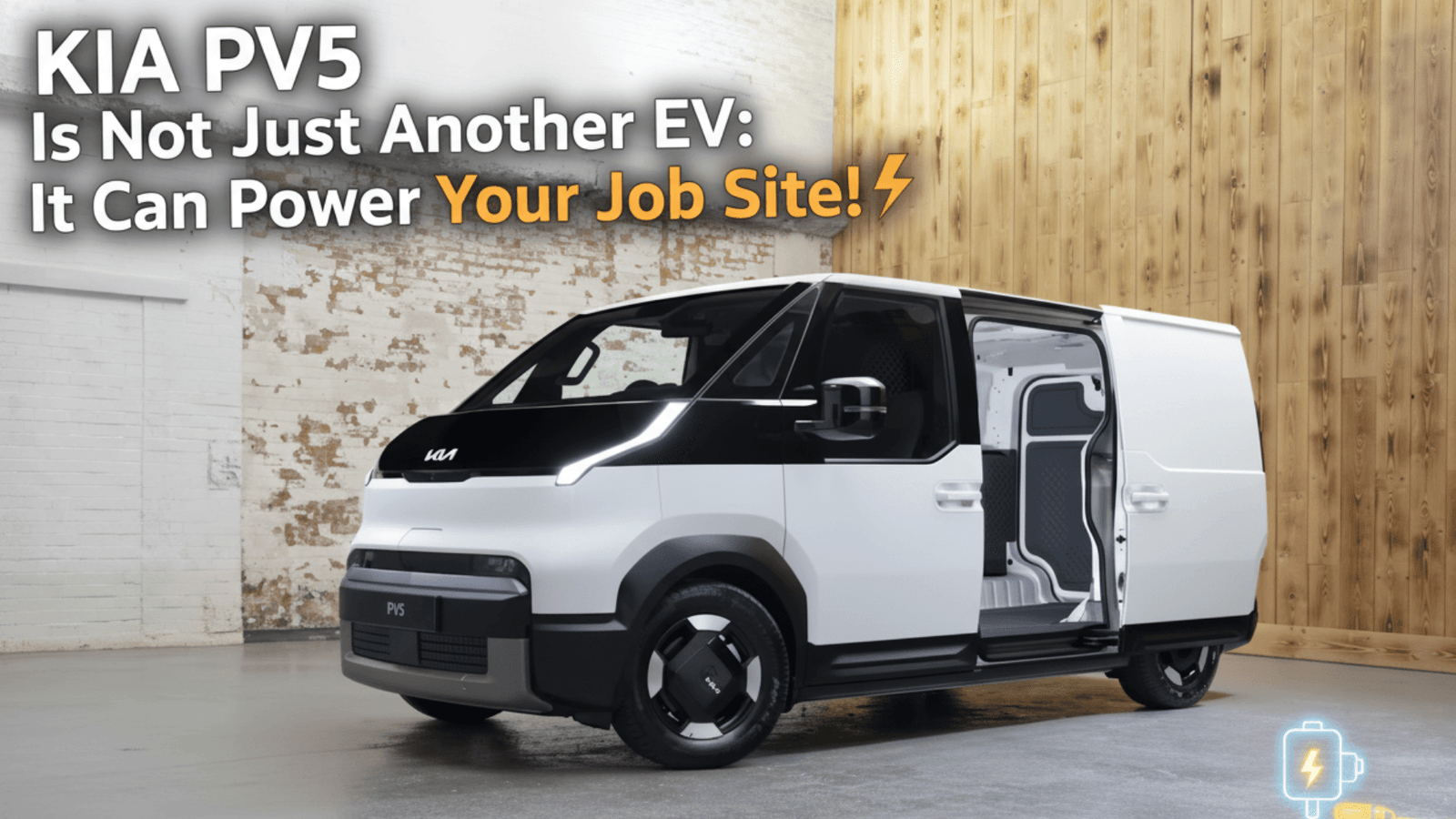
My Expert Verdict: The Kia PV5 is being hailed as a modular delivery van, but its true mission is to retire the noisy, polluting diesel generator. The key is its robust V2L (Vehicle-to-Load) system.
This isn’t just about modularity for taxis; it’s about transforming the construction site. This is the my audit of why the PV5 will redefine vehicle-to-worksite operations.
1. THE HIDDEN POWER: The 3.68 kW Solution That Replaces Your Generator
The Truth: The headline feature isn’t the swappable body; it’s the built-in energy ecosystem. While other outlets focus on aesthetics, the PV5 fundamentally changes the vehicle’s role from transport to a mobile power plant.
Why the PV5 is a Game Changer for Contractors & Trades:
V2L (Vehicle-to-Load) NOW: Every PV5 comes with a robust 3.68 kW external power capability. This is fully operational at launch and provides enough power to run:
Heavy Tools: Commercial chop saws, air compressors, and welding equipment (intermittently).
Site Essentials: Lights, laptops, and charging hubs for power tools (simultaneously).
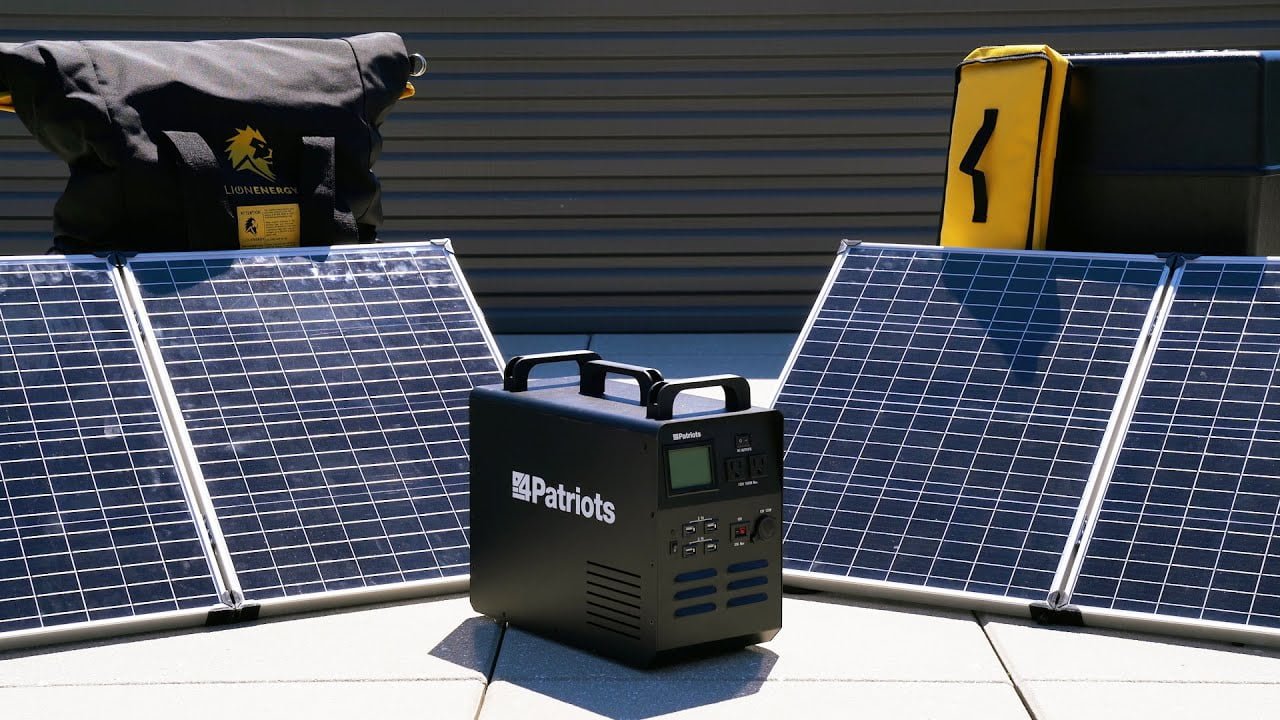
The Diesel Cost Conflict: A noisy 3 kW diesel generator requires fuel, maintenance, and compliance. The PV5 offers silent, emission-free power sourced from the grid or solar.
V2H Gateway (Future-Ready): The architecture is built for V2H and V2G integration. V2H functionality is currently limited but the PV5’s hardware makes it ready for future software updates.
My Insight: This shifts the total cost of ownership (TCO) calculation for fleet managers and trades. The PV5 isn’t just an asset for transport; it’s an investment in energy resilience and operational flexibility.
2. THE SMART BRAINS: Android Automotive OS for Fleet Efficiency
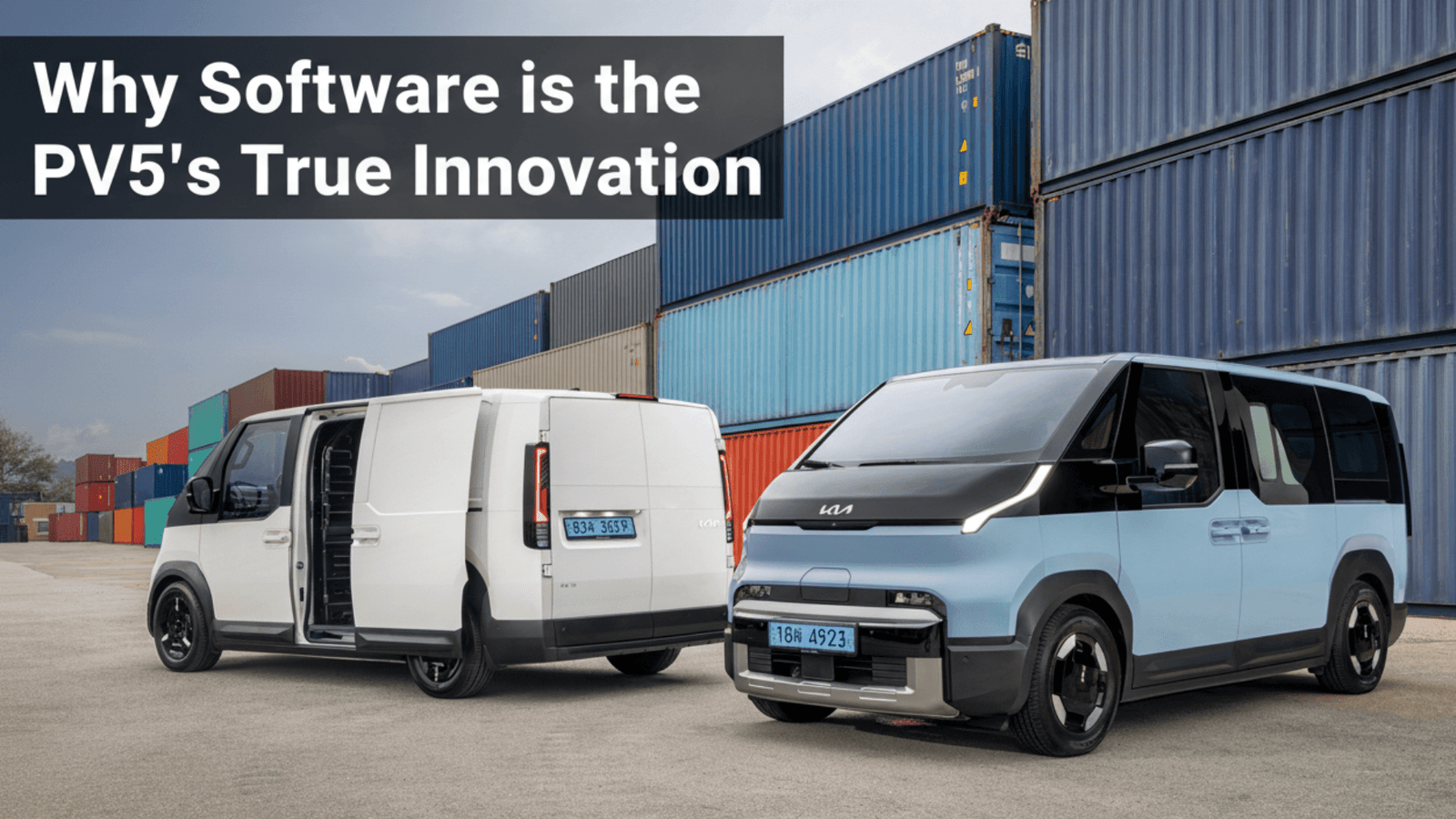
Competitors are missing the biggest story: the PV5 is a software platform on wheels. The modularity extends far beyond hardware; it’s deeply integrated into the operating system.
Why Software is the PV5’s True Innovation:
Android Automotive OS: Kia has embraced this Google-backed operating system, ensuring over-the-air updates and a flexible infotainment foundation.
Pleos Software Platform: The vehicle utilizes the new Pleos App Market, the dedicated software brand launched by Hyundai Motor Group, allowing third-party developers to create bespoke applications tailored for fleet management.
Motor Power Nuance: The maximum power output is 120 kW (≈161 hp). However, the smaller 51.5 kWh battery variant is electronically limited to 89.4 kW (≈120 hp) to prioritize battery longevity.
3. THE BATTERY BATTLEFIELD: NCM vs. LFP Chemistry
Kia’s decision to use two distinct battery chemistries (NCM and LFP) for different PV5 variants is a critical, often-overlooked detail that reveals a sophisticated understanding of commercial vehicle economics.
The Power of Dual Battery Strategy for Fleet Managers:
Chemistry
PV5 Variant (Focus)
Strategic Benefit for Commercial Use
NCM (Nickel Cobalt Manganese)
Passenger Models (51.5 kWh or 71.2 kWh)
High Energy Density: Prioritizes maximum range (up to 412 km WLTP) for passenger transport.
LFP (Lithium Iron Phosphate)
Cargo Models (43.3 kWh option)
Lowest TCO/Cycle: LFP inherently offers superior thermal stability and longer cycle life (Verified Industry Principle). Reduces TCO for high-utilization commercial fleets.
My Audit (Final Specs): The PV5 supports 11 kW AC charging and up to 150 kW DC fast charging (10–80% in ∼30 minutes). It includes a Heat Pump option (for an estimated £780 premium in the UK) for cold-climate efficiency and comes with an exceptional 8-year/100,000-mile battery warranty.
4. ACTIONABLE UTILITY: Calculate Your Worksite Power Audit
The PV5 transforms a parked asset into a functional commercial power source. Use the tool below to determine the exact number of hours the vehicle could power your tools and job site critical needs.
Worksite V2L Power Runtime Calculator
Estimate how long the PV5 can run your tools and charge your equipment.
1. Select Battery Capacity (PV5 Options)
The largest battery offers maximum utility for the job site.
2. Select Tools & Site Load (Watts)
3. Continuous Worksite Runtime
—
hours
**Worksite Reality Check:** Total estimated continuous runtime is X hours. Actual utility is typically **1.5x to 2x** longer since heavy tools run intermittently.
The PV5 is the Blueprint for the Future Energy Grid
The Kia PV5 isn’t merely a new electric van; it’s a fundamental shift in automotive architecture.
It represents the clearest vision yet of how EVs will transition from simple transportation to integrated mobile energy assets within a broader energy ecosystem. Its combination of a powerful software platform, versatile battery options, and robust V2L capabilities means the PV5 is primed to:
Optimize fleet operations and minimize costly downtime through real-time data and custom apps.
Provide crucial, silent power for remote job sites and construction zones.
Become a flexible component of smart grids, enabling bi-directional charging and demand response.
The PV5 is a wake-up call to the industry. The future of commercial mobility isn’t just electric; it’s digitally integrated, energy-resilient, and powered by software.
I’ve been driving, testing, and living with electric vehicles for years — from early compact EVs to today’s high-performance models. My journey into e-mobility started out of curiosity but quickly turned into a mission to help others make smarter EV choices. At VeCharged, I break down real-world ownership insights, cost analysis, and charging know-how so you can buy, sell, or switch to an EV with total confidence.
Vecharged is the consumer protection and education initiative of Cleanpower.eco, an organization dedicated to providing a clear, unbiased, and authoritative voice in the clean energy transition. The experts at Cleanpower.eco recognized a critical crisis of trust: the shift to electric vehicles and solar power is one of the most important and expensive decisions a family will make. Yet, the landscape is flooded with biased reviews, confusing marketing, and paid-for endorsements. Vecharged was created to be the shield against that confusion. We were founded on a simple, non-negotiable constitution: We are radically independent. We accept no advertising, sponsorships, or paid placements from any product manufacturer. We have no commercial interest in the products we review. Our only metric for success is your empowerment. Our loyalty is to you, the consumer. Full stop. We ground our brutally honest, hands-on analysis in a deep, foundational understanding of the engineering. We are not just reviewers; we are your advocates.
Selling an electric car is very different from selling a petrol or diesel vehicle. Buyers today care less about the odometer and more about battery health, charging history, warranty coverage, and software features. The good news is that a well-maintained EV can still command strong resale value if you prepare it properly. This guide gives
By Rahul — EV owner, reviewer, and long-time clean energy enthusiast Financing or leasing an electric car in early 2026 is not the same as it was just one year ago. The biggest shift was the end of all federal EV tax credits on September 30, 2025, including: Manufacturers can no longer claim any of
By Rahul — EV Enthusiast & Automotive Analyst at VeCharged ⚠️ Important Disclaimer (Must Read) The Clean Vehicle Credit program (new EV $7,500 credit + used EV $4,000 credit) ended on September 30, 2025. This single policy change fundamentally shifts the cost comparison between new and used EVs. If you’re planning to buy or sell
For the last decade, the electric vehicle revolution was defined by range, speed, and charging networks. As we close out 2025, the conversation is fundamentally shifting. For a growing number of buyers, the most important feature of their next car won’t be how it drives—but how it powers their life when it’s parked. Vehicle-to-Home (V2H)