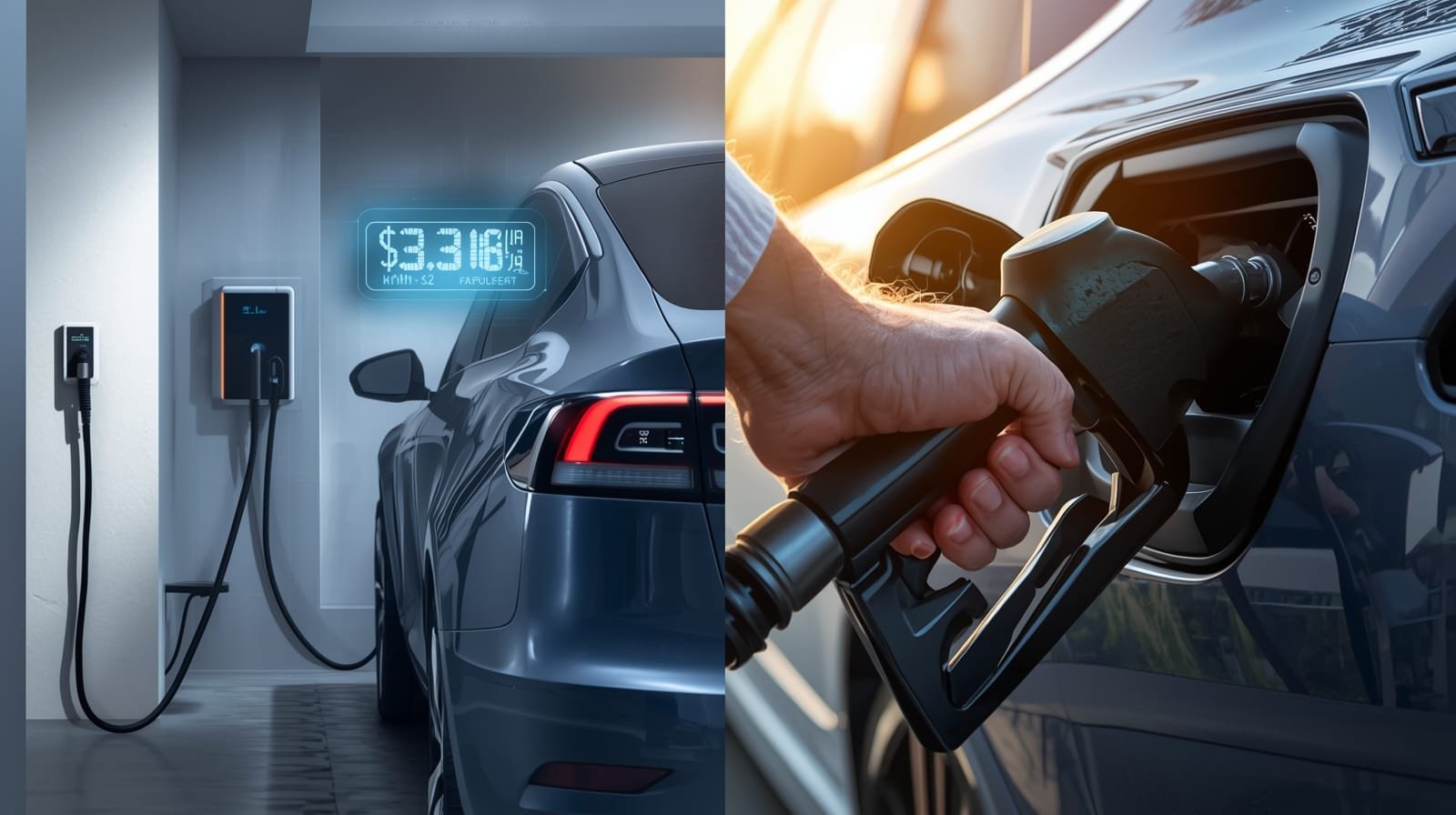
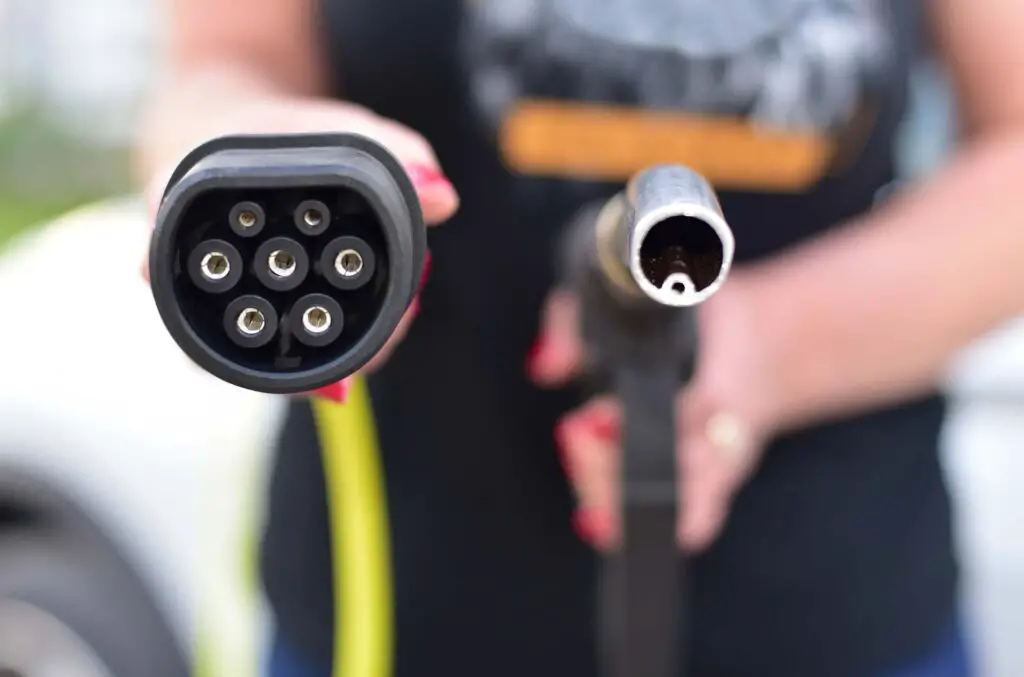
It’s the question I get asked more than any other: “Will I really save money with an electric car compared to buying gas?” You hear the hype, tiny electric bills! Then you hear the horror stories, shocking costs at public chargers! So, what’s the real deal in late 2025?
Let’s cut through the noise. I’ve crunched the latest numbers from sources like the EIA and AAA, and the answer is a resounding YES… but it comes with some massive asterisks. The savings are real, often huge, but only if you understand the game. Let me break down the facts, engineer-style.
Step 1: The Raw Price of “Fuel” (It Varies WILDLY)
First, let’s compare the cost of energy.
Electricity (for EVs): The US average residential price is around $0.175 per kilowatt-hour (kWh).
Gasoline (for Petrol Cars): The US national average for regular gasoline is hovering around $3.18 per gallon.
The HUGE Catch: That electricity average hides massive regional differences. If you live in California (average ~$0.35/kWh) or Hawaii (~$0.42/kWh!), your baseline charging cost is dramatically higher. Conversely, states like Washington or Idaho offer much cheaper power. Your location is critical.
Step 2: Efficiency – How Far Does Your Money Go?
Price per unit means nothing without efficiency.
Typical EV (Think Tesla Model Y, Hyundai Ioniq 5): Averages around 3.3 miles per kWh in real-world driving. Smaller EVs might hit 4.0+ mi/kWh.
Comparable Gas Car (Think Toyota RAV4, Honda CR-V): Averages around 28 miles per gallon (MPG). Efficient hybrids can do much better (40-50 MPG), narrowing the gap.
Now, let’s calculate the Cost Per Mile using national averages:
Vehicle Type
Average Efficiency
Average Fuel/Energy Cost
Cost Per Mile (Charging at Home)
Electric Vehicle
3.3 miles/kWh
$0.175 / kWh
≈ $0.053
Gasoline Car
28 MPG
$3.18 / Gallon
≈ $0.114
(Calculations based on US national averages, late 2025. Your results WILL vary based on location & vehicle.)
The result is stark: When charging at home, driving the average EV costs less than half as much per mile as the average new gas car.
Step 3: The GIANT Asterisk – WHERE You Charge Changes EVERYTHING
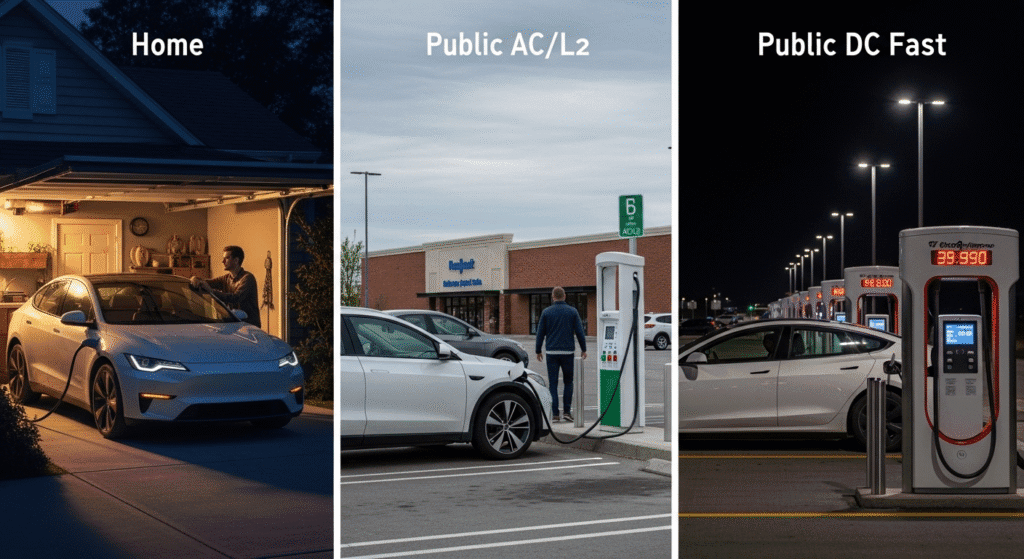
This is the non-negotiable truth. Those incredible savings? They depend on charging at home. If you primarily rely on public DC fast chargers, the financial picture flips.
Home Charging: ≈ $0.175 / kWh = ~$0.05 per mile (National Avg.)
Public DC Fast Charging (Pay-As-You-Go): Averages $0.36/kWh, but can easily hit $0.50-$0.60+/kWh = ~$0.11 to $0.18+ per mile!
The Brutal Reality: Using pay-as-you-go fast chargers frequently can make driving an EV just as expensive, or even MORE expensive, than driving a gas car.The Nuance: Many drivers use subscription plans (Tesla Supercharger, Electrify America), which can lower the average public charging cost to around $0.25-$0.40/kWh, keeping it more competitive with gas. But nothing beats home charging for savings.
Step 4: The Upfront & Hidden Factors
Home Charger Installation: Budget $1,000 to $1,500 for a professionally installed Level 2 charger. This is key for convenient and cheap overnight charging.
Your Secret Weapon – TOU Rates: Ask your utility about Time-of-Use (TOU) plans. Charging during off-peak hours (usually overnight) can drop your electricity cost to $0.10-$0.15/kWh, potentially doubling your savings.
Minor Considerations: Yes, EV batteries lose a tiny bit of efficiency (maybe 2-5% over many years), and cold weather can temporarily reduce range by 15-25%, slightly increasing winter costs per mile. But these effects are minor compared to the core savings from home charging.
Step 5: Your Real-World Annual Savings (It Varies!)
Let’s use the US average driving distance of 13,500 miles per year.
Gas Car: 13,500 miles / 28 MPG * $3.18/gallon = ≈ $1,535 per year
EV (Home Charging at Avg Rate): 13,500 miles / 3.3 miles/kWh * $0.175/kWh = ≈ $716 per year
This aligns with major analyses showing average savings around $700 – $1,050 per year. However, your actual savings could range from ~$400/year in high-cost states like California to over $1,200/year in states with cheap electricity like Washington or Texas.
The Verdict: Cheaper? YES. Simple? NO.
So, is EV charging cheaper than gas? Absolutely, IF you can charge at home. That is the brutal, unavoidable truth. Public fast charging is a convenience, not a primary fueling strategy for saving money.
You need access to home charging (or maybe reliable workplace charging) and you need to factor in the initial charger installation. But once you’re set up, the dramatically lower cost per mile makes the switch to an EV a financially winning move for most American drivers. The savings are real, they are significant, and the numbers don’t lie.
I’m a writer and analyst who explores the clean energy transition, with a focus on electric vehicles and solar power.
My journey began five years ago as a firm skeptic. Determined to debunk the hype around EVs, my in-depth research led to an unexpected conclusion: the future I was questioning was already here. This realization didn’t just change my mind; it put me in the driver’s seat of my own EV.
Today, I’m passionate about sharing the clarity I found. I provide the practical, data-driven insights people need to feel confident and excited about navigating their own path to a sustainable future.
Vecharged is the consumer protection and education initiative of Cleanpower.eco, an organization dedicated to providing a clear, unbiased, and authoritative voice in the clean energy transition. The experts at Cleanpower.eco recognized a critical crisis of trust: the shift to electric vehicles and solar power is one of the most important and expensive decisions a family will make. Yet, the landscape is flooded with biased reviews, confusing marketing, and paid-for endorsements. Vecharged was created to be the shield against that confusion. We were founded on a simple, non-negotiable constitution: We are radically independent. We accept no advertising, sponsorships, or paid placements from any product manufacturer. We have no commercial interest in the products we review. Our only metric for success is your empowerment. Our loyalty is to you, the consumer. Full stop. We ground our brutally honest, hands-on analysis in a deep, foundational understanding of the engineering. We are not just reviewers; we are your advocates.
The Bottom Line The 2026 BMW iX3, the first vehicle on the Neue Klasse platform, is a strategic pivot, not an incremental update. Its 800-volt architecture enables a charging speed (400kW) and system efficiency that renders most current 400-volt luxury EVs technically obsolete. This platform isn’t a feature; it’s a new engineering benchmark that forces
The Bottom Line: The Sondors Metacycle is a cautionary tale. It is a stunning piece of industrial design that promised to revolutionize the electric motorcycle market, but was ultimately crippled by production compromises, broken promises, and a final product that failed to live up to its own revolutionary hype. For the few who received one,
The Bottom Line: A solar panel is an essential, transformative upgrade for any battery-powered Ring device. For guaranteed compatibility and the best weather sealing, Ring’s official 4W Solar Panels are the benchmark. However, for users seeking more placement flexibility and value, leading third-party options from brands like Wasserstein offer more power and longer cables for
Executive Summary: The State of Charger Anxiety in America 1.1 The New Frontier of EV Ownership For the past decade, the primary psychological barrier to mass electric vehicle (EV) adoption has been “range anxiety”—the driver’s fear that their battery will run out before reaching their destination or a charging station. Advances in battery technology have