For homeowners, the most critical decision when going electric is not the car—it’s the charger. The market is saturated with options, but the true cost lies hidden within your home’s electrical panel.
The best Level 2 charger on the market is useless if your home can’t power it. This guide provides the definitive, expert-backed strategy for choosing the best Level 2 charger for your needs, avoiding unnecessary panel upgrades, and maximizing your Return on Investment (ROI).
⚡️ EXPERT ADVICE: Your electrician will tell you to upgrade your panel. As an engineer, my advice is simple: **Don’t. The solution to 11.5 kW charging is software, not a costly new 200-Amp panel.**
Home Charging Readiness & Risk Assessor
Determine your panel’s risk level before consulting an electrician.
Check the main breaker at the top of your panel.
Major 240V appliances (A/C, Electric Stove, Dryer, Water Heater, Pool Heater).
48A requires a 60A breaker; 32A requires a 40A breaker.
Your Electrical Readiness
Calculating Risk…
Select options above to assess your home’s capacity.
1. The Real Cost: Charger Price vs. Installation Cost
The biggest mistake a homeowner makes is focusing only on the charger’s purchase price (typically $400–$1,200). In reality, the hardware is a minor expense; the installation is the variable cost that determines your total outlay.
Variable (Ranges from $1,300 to $6,000 regionally for a 200A)
HIGH (The single largest hidden cost).
Permits & Inspection
$50 – $300
Fixed (Mandatory for safety/code)
Low (But required for safety and warranty).
MANDATORY TAX CREDIT CLARIFICATION (§30C)
The federal $1,000 Section 30C Tax Credit for home charger installation is NOT universally available.
To qualify, your principal residence must be located in an eligible census tract, defined as either a low-income community or a non-urban (rural) area. If you live in an established metropolitan suburb or affluent urban center, you likely do not qualify.
TIME SENSITIVITY:Check the June 30, 2026, Deadline
The deadline for the §30C credit is June 30, 2026. The property must be placed in service (installed and operational) by this date to qualify. Do not delay installation if you plan to claim this incentive.
What is the lifespan of a home EV charger?
Most Level 2 chargers have a lifespan of 7–10 years, with warranties typically covering 3 years. The longevity of the unit is often less critical than the lifespan of your installation investment, which should last 20+ years.
The Daily Charge: Home EV charging integrates seamlessly into the family routine, ensuring the vehicle is always ready for the morning commute and school run.
2. Speed and Power: Debunking the 22kW Myth
Home charging speed is not determined by the charger alone; it is limited by your car and your home’s electrical supply.
Can I install a 22kW charger at home?
The 22kW charging standard is a three-phase power requirement, which is common in Europe.
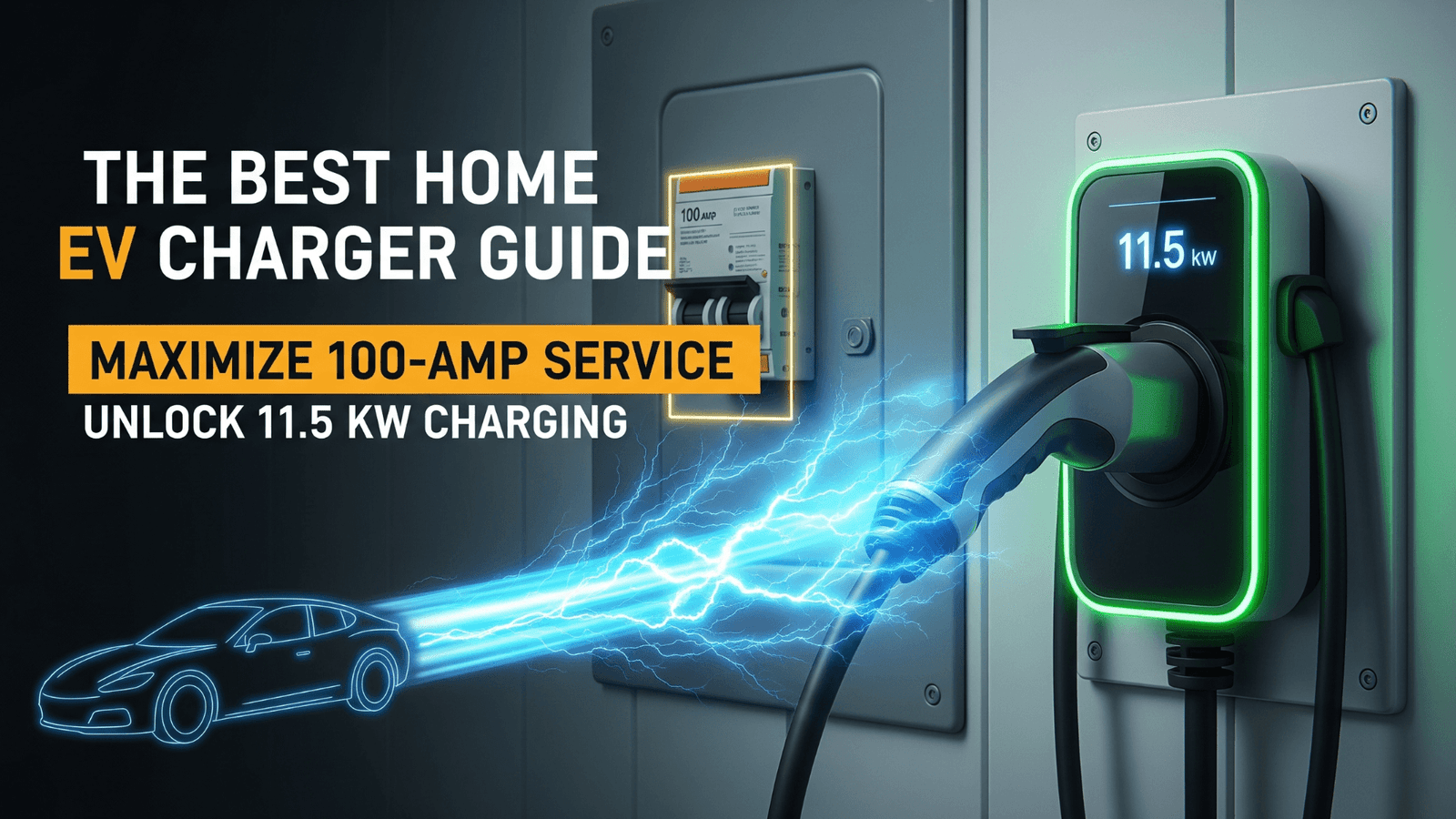
The U.S. Reality: The practical maximum for a residential charger in the U.S. is 11.5 kW (48 Amps on a 60 Amp breaker).
The Feasibility Nuance: Installing a 22kW charger is technically possible only if your home already has a three-phase power supply or you pay for an extremely costly utility service upgrade. For all practical purposes, a 7–11 kW charger is the best and most cost-effective choice.
Technical Deep Dive: The 80% Rule
What is the 80% rule for EV charging?
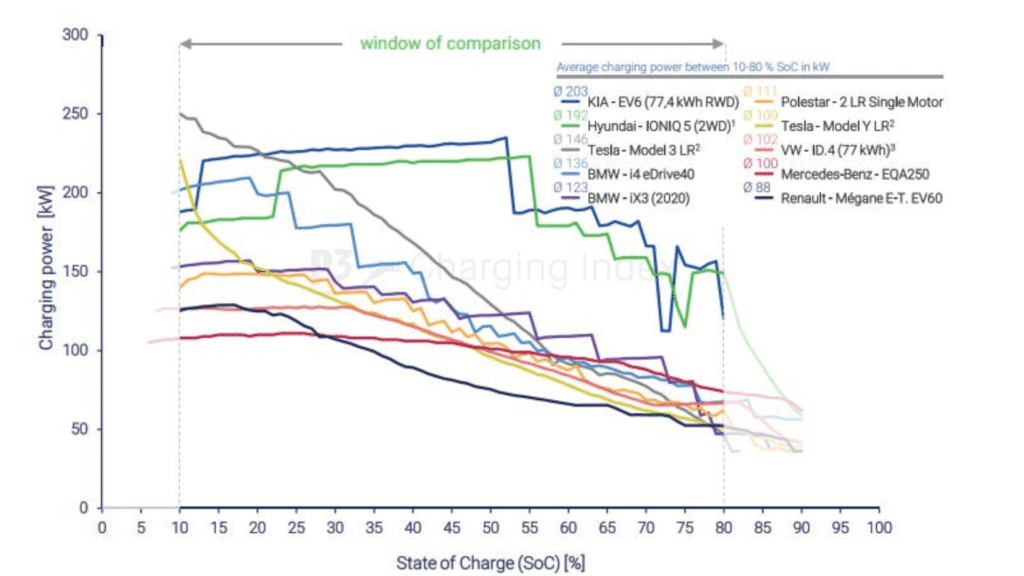
The 80% Rule is a critical battery longevity and efficiency strategy. It dictates that you should rarely charge your lithium-ion battery above 80% for daily use.
Longevity (Battery Health): Charging the final 20% pushes high voltage into the battery, generating excess heat and stress that accelerates chemical degradation, thus reducing the battery’s overall lifespan.
Efficiency (Time & Money): The charging curve tapers significantly after 80%. That final 20% can take as long as the first 80%, wasting time at public chargers and increasing your electricity cost.
The Reality of Fast Charging: This industry-standard graph compares the charging curves of leading EVs, revealing the average power delivered between 10% and 80% State of Charge (SoC).
3. Best-in-Class Chargers: Features vs. Price
Which are the top 5 EV charger manufacturers?
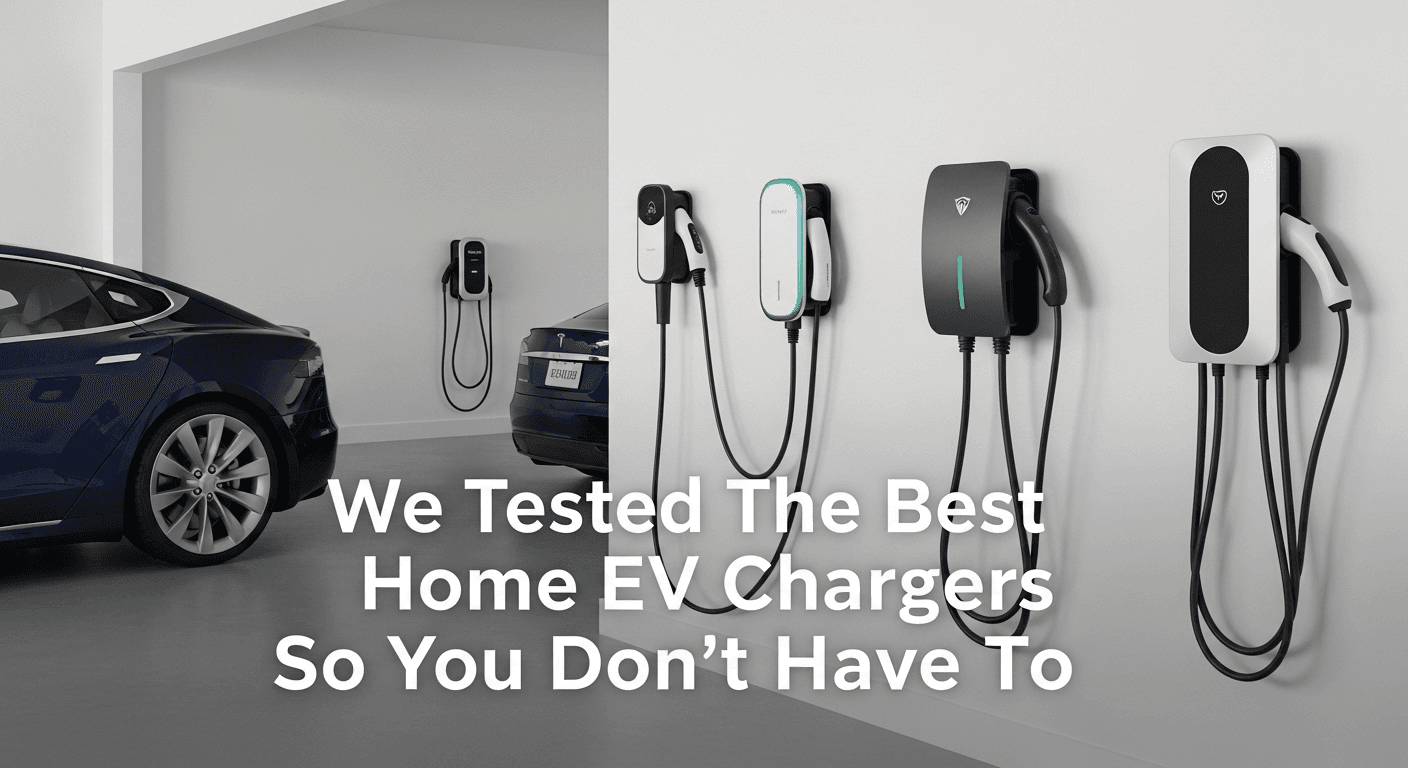
The “best” charger is the one that manages your home’s energy. We prioritize Smart Chargers with Load Management capability, which are essential for avoiding costly panel upgrades.
Charger Model
Key Feature / Vecharged Verdict
PAA/PASF Relevance
ChargePoint Home Flex
Ecosystem Leader. Excellent app integration and networking for users who also charge publicly. (Highest user trust score).
Smart Home Integration. Best value for load management; automatically balances power between your car and other major appliances (A/C, oven) to avoid tripping the main breaker.
Durability & Value. Non-smart, robust, high-amperage, and built to withstand harsh weather. The best value if smart features aren’t needed.
*Grizzl-E, Best Level 2 EV charger for home*
4. Avoiding the Hidden Panel Upgrade Cost
The biggest differentiator between a simple $950 installation and a $5,500 project is your electrical service panel.
The Threat: If your home has a 100-amp panel (common in older homes) and you install a 40–50 Amp circuit for an EV, you risk overloading the panel and failing inspection.
The Vecharged Solution: Load Management: Instead of paying $1,500–$2,500+ for a full 200-amp panel upgrade, invest $400–$800 in a Load Management Device (like those integrated by Emporia or Wallbox). This device dynamically slows your EV charging when the A/C or dryer is running, ensuring you stay under the panel’s capacity limit.
Actionable Takeaway: Your Budget Scenario
Use our calculator to get a realistic cost forecast based on your home’s needs:
Home Charger Cost & Installation ROI Calculator
Audit the true cost of Level 2 charging versus public charging.
1. Your Upfront Installation Cost
Typical range is $800–$1,500 for a simple install.
Enter **$0** if you plan to use Smart Load Management.
2. Annual Operating Savings
US Average Public Rate is ~36.5¢/kWh (Fast/DC charging premium).
I’ve been driving, testing, and living with electric vehicles for years — from early compact EVs to today’s high-performance models. My journey into e-mobility started out of curiosity but quickly turned into a mission to help others make smarter EV choices. At VeCharged, I break down real-world ownership insights, cost analysis, and charging know-how so you can buy, sell, or switch to an EV with total confidence.
Vecharged is the consumer protection and education initiative of Cleanpower.eco, an organization dedicated to providing a clear, unbiased, and authoritative voice in the clean energy transition. The experts at Cleanpower.eco recognized a critical crisis of trust: the shift to electric vehicles and solar power is one of the most important and expensive decisions a family will make. Yet, the landscape is flooded with biased reviews, confusing marketing, and paid-for endorsements. Vecharged was created to be the shield against that confusion. We were founded on a simple, non-negotiable constitution: We are radically independent. We accept no advertising, sponsorships, or paid placements from any product manufacturer. We have no commercial interest in the products we review. Our only metric for success is your empowerment. Our loyalty is to you, the consumer. Full stop. We ground our brutally honest, hands-on analysis in a deep, foundational understanding of the engineering. We are not just reviewers; we are your advocates.
With powerful motors, torque sensors, and UL-certified batteries, Tuttio is making a bold play against the giants. We break down if this emerging brand is a true contender or just another face in the crowd. The direct-to-consumer e-bike market is the new Wild West. Every month, a new brand appears, promising more power, more features,
With up to 100kWh of capacity and all-terrain tracks, these mobile power plants are in a class of their own. We break down the Commercial, Residential, and Mini models to reveal who should—and shouldn’t—buy into this rugged new ecosystem. For years, the “portable power station” market has been a race of numbers—more watt-hours, more inverter
From small garden fountains to powerful well pumps, solar energy is revolutionizing how we move water. This is the Vecharged definitive guide to the technology, the sizing, the installation, and the costs. Water is the essence of life, but moving it often requires a connection to a power grid that can be expensive, unreliable, or
Europe’s EV market is a fascinating glimpse into the future. With a stunning 29% market share, the data shows three clear winners and one surprising trend that could be coming to the US next. The world of electric vehicles is moving at lightning speed, but if you want a real glimpse into the future, you