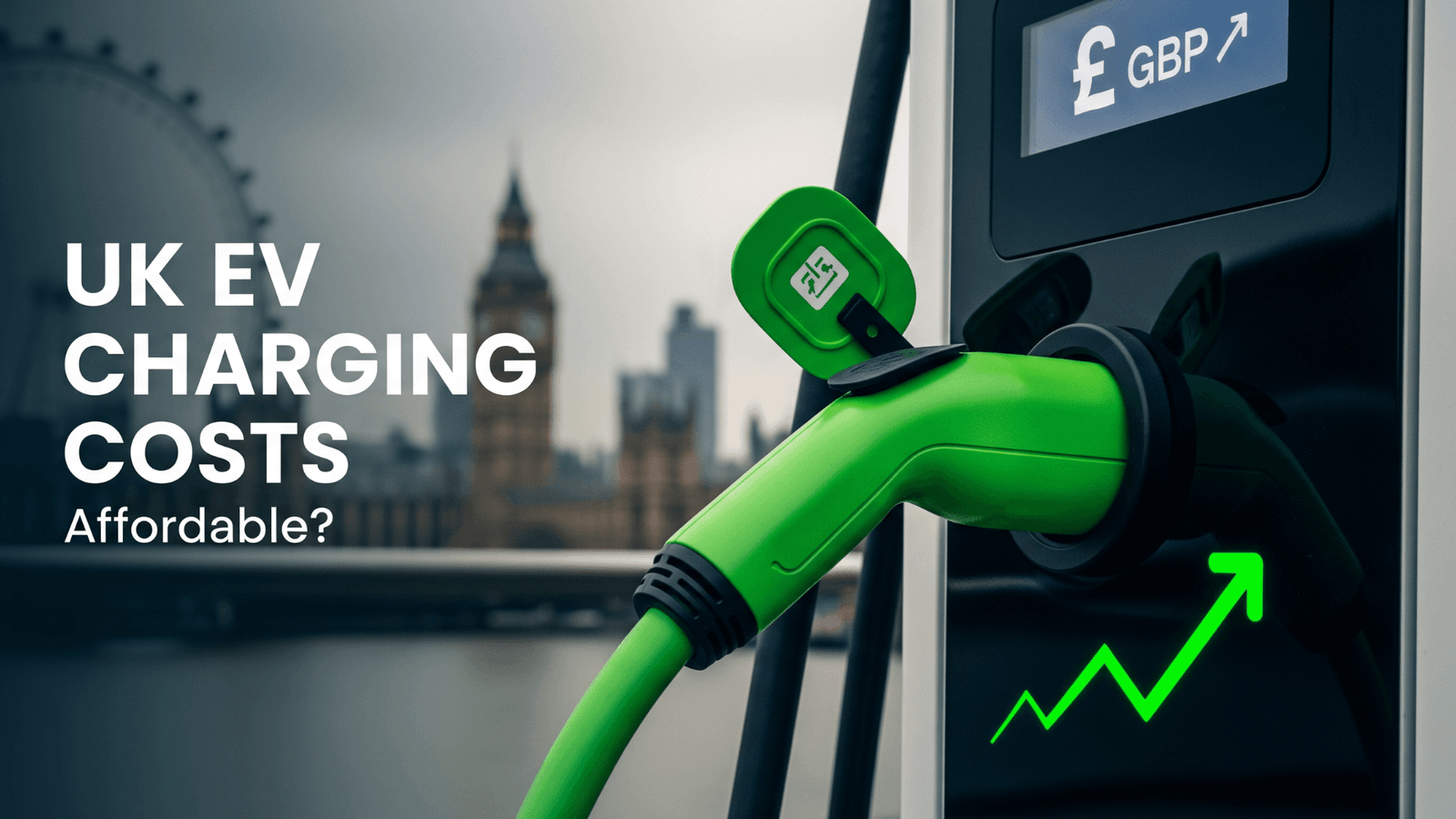
If you’re driving an electric vehicle (EV) in the UK, you already know the promise: lower running costs. But the moment you leave your driveway, you enter a confusing marketplace of rapid chargers, p/kWh pricing, and membership fees. Is public charging really affordable, or is it a hidden tax on convenience?
I’m going to give you the honest audit. The financial equation for public charging is complex, but by breaking down the true cost of speed and reliability, we can determine the single most effective way to save money and frustration on the road.
THE HARD TRUTH: The Public Charging Price Shock
The biggest financial mistake a UK EV driver makes is relying solely on rapid chargers without a subscription. The price difference between charging at home and charging publicly is substantial.
Is public EV charging cheaper than home charging in the UK?
No. Public charging is significantly more expensive than home charging.
Home Charging: With off-peak tariffs (like Octopus Go), home charging can cost as low as 7p to 8p per kWh.
Public Charging (Rapid/Ultra-Rapid): The average Pay-As-You-Go (PAYG) rate is between £0.71 and £0.89 per kWh.
Public ultra-rapid charging costs the UK driver up to 10 times more than charging at home during off-peak hours.
Auditing the Cost of Speed
Public charging speeds are categorized by output (kW), and that speed dictates the price you pay. Here is the current reality for PAYG prices at 150kW+ chargers:
Network
Ultra-Rapid PAYG Rate
Notes on Price Structure
BP Pulse
£0.89 per kWh
Requires a £7.85 monthly subscription to access lower, competitive rates.
Gridserve
£0.79 – £0.85 per kWh
Pricing is transparent and fixed but high; often seen at major Electric Forecourts.
IONITY
£0.74 (PAYG)
Best Subscription Value: Offers the best value if you enroll via an OEM/Membership plan (dropping rates to ~£0.43 – £0.53 per kWh).
InstaVolt
£0.85 per kWh
Fixed high rate; prioritizes ease of use (contactless) over affordability.
The charging network isn’t selling electricity; it’s selling urgency. That high PAYG rate is the tax you pay for lack of planning.
📉 Annual EV Charging Savings Estimator
Find out how much you could save each year by switching from Pay-As-You-Go (PAYG) to smarter charging tariffs.
Your Annual Savings Potential
Total Annual Savings (PAYG to Home Off-Peak)
£1,939
*Based on typical UK Ultra-Rapid PAYG ($\mathbf{85p/kWh}$) vs. Off-Peak Home Rate.
What are the main frustrations with public EV charging in the UK?
The top frustrations are Reliability and Complexity:
Failure Rate: The overall session success rate for non-Tesla networks is only 71.3%. Up to 35% of reported failures occur on units that officially register as “operational,” signaling software/interoperability issues.
Complexity: Users must navigate a fragmented ecosystem of apps, RFID cards, and conflicting payment systems, leading to “app fatigue”.
Congestion: During peak travel times, the risk of queuing is high, forcing drivers to pay expensive idle fees or waste valuable time.
THE SOLUTION: Strategic Savings for the UK Driver
You can mitigate both cost and reliability risk by adopting a dual-strategy approach:
The Smart Tariff Defense: Switch to a Time-of-Use (TOU) tariff (e.g., Octopus Intelligent Go) that offers extremely low rates (as low as 7p/kWh) for overnight home charging. This ensures the majority of your energy is bought cheaply.
The Membership Leverage: If you are a high-mileage driver, never use the PAYG rate. Pay the monthly subscription fee (e.g., BP Pulse’s £7.85) to access the 20% membership discount. The fee pays for itself in just a few charging sessions.
The Infrastructure Shift: Future regulations will force highway charging sites to offer a minimum of 150kW and 400kW total power output, meaning speed and availability on major roads will continue to improve.
Final Action: Charging at home is always the cheapest option. When you must charge publicly, view subscriptions not as a cost, but as essential insurance against the highest PAYG rates.
I’ve been driving, testing, and living with electric vehicles for years — from early compact EVs to today’s high-performance models. My journey into e-mobility started out of curiosity but quickly turned into a mission to help others make smarter EV choices. At VeCharged, I break down real-world ownership insights, cost analysis, and charging know-how so you can buy, sell, or switch to an EV with total confidence.
Vecharged is the consumer protection and education initiative of Cleanpower.eco, an organization dedicated to providing a clear, unbiased, and authoritative voice in the clean energy transition. The experts at Cleanpower.eco recognized a critical crisis of trust: the shift to electric vehicles and solar power is one of the most important and expensive decisions a family will make. Yet, the landscape is flooded with biased reviews, confusing marketing, and paid-for endorsements. Vecharged was created to be the shield against that confusion. We were founded on a simple, non-negotiable constitution: We are radically independent. We accept no advertising, sponsorships, or paid placements from any product manufacturer. We have no commercial interest in the products we review. Our only metric for success is your empowerment. Our loyalty is to you, the consumer. Full stop. We ground our brutally honest, hands-on analysis in a deep, foundational understanding of the engineering. We are not just reviewers; we are your advocates.
Innovations in Agrivoltaics A powerful solution is transforming agricultural landscapes: the integration of solar farms with active farming. This approach, known as agrivoltaics or dual-use solar, enables the simultaneous production of food and clean energy on the same piece of land. By mounting solar panels high above crops or livestock, this strategy optimizes land use, conserves valuable
My Expert Verdict: The Kia PV5 is being hailed as a modular delivery van, but its true mission is to retire the noisy, polluting diesel generator. The key is its robust V2L (Vehicle-to-Load) system. This isn’t just about modularity for taxis; it’s about transforming the construction site. This is the my audit of why the
I was in my office the other day, and I realized something was missing: the familiar clatter and roar of the diesel delivery truck that usually rattles the windows around lunchtime. It was replaced by a near-silent, electric hum. That’s when it hit me. For years, we’ve talked about the “future” of electric delivery. But
My Expert Verdict: The Kia PV5 is being hailed as a modular delivery van, but that’s a distraction. This vehicle is Kia’s most strategically important platform because it’s a massive software hub, a dynamic battery battlefield, and a Vehicle-to-Home (V2H) Trojan horse. This isn’t just about interchangeable bodies. It’s about how electric vehicles will integrate